


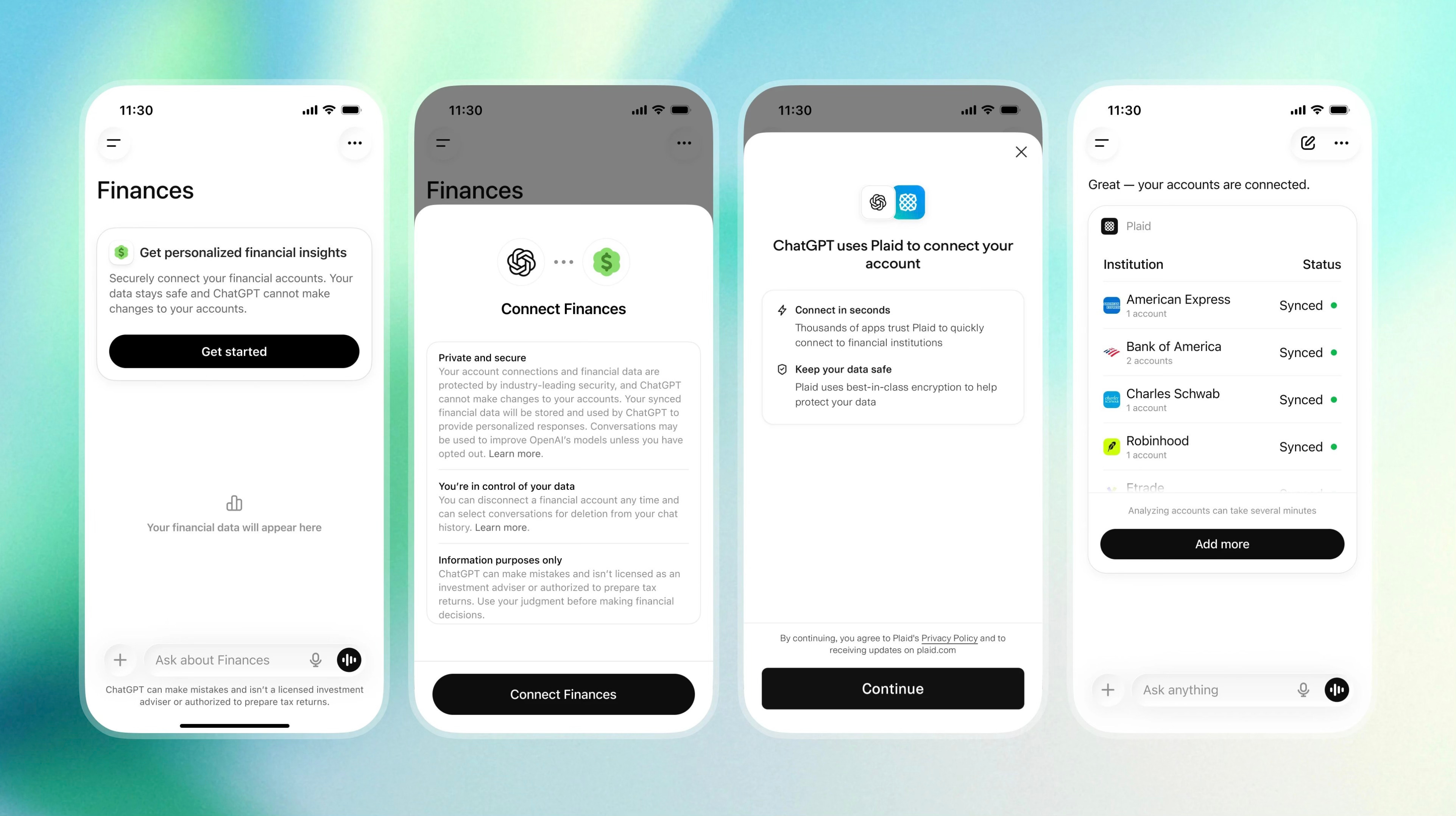
OpenAI just connected ChatGPT to 12,000 banks and brokerages. Chase. Fidelity. Schwab. Robinhood. AmEx. Real transaction data. Real portfolio positions. Real liabilities. All feeding into a conversational layer that hundreds of millions of people already open before they open any financial app.
That’s not a fintech feature. That’s a category extinction event.
And the first company in the crosshairs isn’t a legacy bank. It’s Revolut.
Why Revolut specifically?
Because Revolut’s entire value proposition is the interface layer. Revolut didn’t build a bank. They built the most beautiful, most intuitive way to see and move your money. The moat isn’t the ledger, the FX engine, or the card network. Those are commodities. The moat is the experience. The clarity. The feeling that you actually understand what’s happening with your money.
That moat just got erased.
When ChatGPT can answer “should I move my Revolut savings into the market right now, based on my actual spending this month and my existing portfolio?” in a single conversational turn, grounded in your real data, Revolut’s dashboard becomes a data source. Not a destination.
You lose the relationship. You become the plumbing. And plumbing doesn’t command a $45B valuation.

First, credit where it’s due.
Dmitry Zlokazov, Revolut’s Global Head of Product, said something genuinely sophisticated on Lenny’s podcast: Revolut never compromises on UX, even on MVPs. If you ship a bad experience, you can’t tell whether poor traction is a bad idea or bad execution. Most companies don’t have that principle.
Lorenzo Mengolini and Margarida Botelho, Lead Product Designers at Revolut, have talked publicly about what it takes to design financial features that make sense to people when millions rely on them every day.
These are serious designers working on a genuinely hard problem. And yet the Wealth & Trading product has three gaps that no amount of “wow” polish fixes. OpenAI’s move exposes all three simultaneously.
Gap 1: The information hierarchy is built for people who already understand finance.
Open Revolut’s trading screen. Price. Chart. Buy/Sell. Volume. 52-week range. That’s a great UI for someone who already knows what 52-week range means and why it matters right now. For the 70 million customers who don’t, it’s a beautiful wall.
Nik Storonsky reviews 100% of screens before they ship. That’s an extraordinary commitment to quality. But reviewing screens catches visual problems, not conceptual ones. The conceptual problem is that the UI assumes a user who arrived ready to trade. Most arrived curious, unsure, and looking for a reason to act or not act.
That gap, between curiosity and confidence, is exactly what a conversational AI fills in one turn.
Lorenzo Mengolini has talked about asking “the number one question before starting any design project.” I’d bet that question isn’t being asked about the 60 million Revolut users who have never made a single trade.
What’s missing: A “why this matters now” layer. Not more data. Contextual interpretation. The difference between showing a stock is down 4% and telling someone whether that’s noise or signal, given their portfolio and risk history.
Gap 2: The onboarding cliff for wealth products is still a cliff.
Revolut’s core onboarding is world-class. Account setup in minutes. Card in the app immediately. Money moved before you finished your coffee.
The Wealth & Trading onboarding is a different product designed by different people with different assumptions. KYC prompts that feel like compliance forms. Risk questionnaires that read like insurance paperwork. A “Stocks” tab that appears when you’re ready, but never explains why you might want to be ready.
The problem is that wealth onboarding was designed for a user who opted in intentionally. Most Revolut users discover it accidentally, mid-session, while looking for something else.
What’s missing: A journey that starts from where the user actually is. “You just got paid £3,200. Here’s what people like you do with money they don’t need this month” is a product moment. The current flow doesn’t have it.
Gap 3: There is no memory layer. This is the deepest one.
Every time a Revolut user opens the trading screen, the product has no idea who they are beyond their holdings. It doesn’t know they panic-sold last October. It doesn’t know they check prices every morning but haven’t traded in six months. It doesn’t know they asked a friend about ETFs last week and came back.
ChatGPT, connected to their actual transaction history, does know those things. Or will.
Revolut has 70 million customers’ worth of behavioural data. That asset should be powering a personalised financial intelligence layer. Instead, it powers a chart that looks the same for everyone.
Dmitry describes Revolut’s product owners as “local CEOs” with genuine end-to-end ownership. That model is built for shipping features fast. It’s not obviously built for the longitudinal, behavioural product thinking that a memory layer requires. That’s a structural gap, not a talent gap.
What’s missing: A personalisation engine that uses existing transaction, savings, and trading behaviour to make the Wealth product feel like it knows who you are. “Based on how you’ve managed money over the past year, here’s what we’d suggest you look at this quarter” is not technically hard for Revolut to build. It just hasn’t been prioritised.
Now, what OpenAI is probably getting wrong.
Because this isn’t a one-sided story.
Mistake 1: Trust without a track record. The same user who asks ChatGPT for restaurant recommendations will not immediately trust it with “Should I sell my ISA?” ChatGPT is a tool for questions. Financial decisions feel like relationships. Revolut has a relationship with 70 million customers. That is nothing.
Mistake 2: Accuracy without accountability. When ChatGPT gets a recipe wrong, you throw out dinner. When it gets a portfolio recommendation wrong, you lose money. OpenAI is moving into a space where the cost of being wrong is asymmetric, without a regulated financial advisory framework underneath. That’s a regulatory exposure Revolut, as a licensed entity, doesn’t have.
Mistake 3: Conversation without action. ChatGPT can tell you what to do. It cannot do it. The moment of maximum drop-off in any financial decision is the gap between intent and execution. The product that closes that gap, from insight to executed trade in one flow, wins. OpenAI needs a brokerage licence for that. Revolut already has one.
The window.
Build the AI interpretation layer on top of your own data, before someone else does it on top of your data. You have the data. You have the relationship. You have the execution rails. You are missing the intelligence layer that turns all of it into a personalised financial experience.
That is the product brief for the next three years.
The companies that win the next decade of fintech won’t be the ones with the prettiest dashboards. They’ll be the ones that become the AI layer, not the ones that got disintermediated by it.
I’ve spent two years building BuzzBets.ai, a real-time market intelligence platform for retail traders, and leading Helvetica Digital, an AI infrastructure studio for family offices and private banks. The gap between data and decision is what I work on every day.
Dmitry, Lorenzo, Margarida, I’d genuinely love to hear where I’m wrong on this. Drop your take below.
#fintech #wealthtech #productdesign #UX #AI #Revolut #OpenAI #trading #LLM #productmanagement