


This is part one of four. Over the last month I wrote four issues of this newsletter and sent none of them, because the argument in them kept growing and I wanted to see where it landed before I hit send. It landed somewhere worth reading. The four pieces trace one idea from August into September: generation became cheap, judgment did not, and almost every fight in design right now is a fight about that gap. Here they are, in order.
On a Wednesday morning in early August, a regulatory filing landed with the SEC. Dylan Field, CEO of Figma, had voluntarily forfeited roughly 2.4 million Class B shares, stock awards worth about $46 million. No replacement awards. No restructured package. Just gone, as a gesture to investors worried that generative AI will make design tools obsolete.
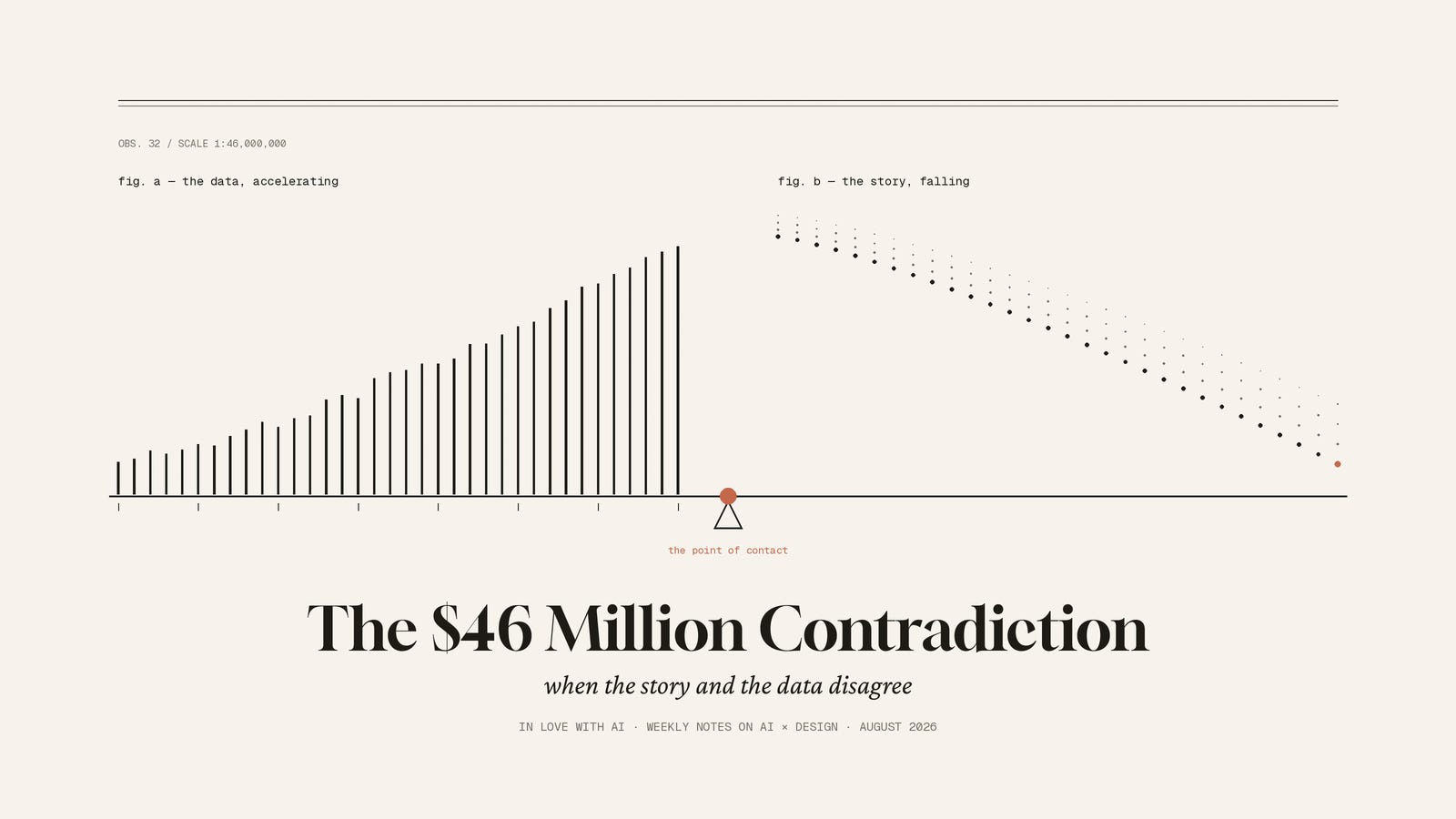
Here is the part that should stop you. The filing came one day after Figma reported its third consecutive quarter of accelerating revenue growth and raised its full-year guidance. Revenue was $370.1 million, up 48% year over year. The full-year outlook went up by $40 million to roughly $1.465 billion. Seat expansion was up. AI adoption inside the product was up, and it was the first full quarter of AI credit monetisation, with more than 80% of paid customers above $10,000 in annual recurring revenue consuming AI credits weekly.
By every operating metric Figma publishes, the business was healthier than it had been since the IPO. And the CEO paid $46 million to say sorry.
So which is it? Is design software dying or thriving?
Both stories were running at full speed, and they could not both be right.
The bear case is easy to tell, which is exactly why it spreads
If a prompt can generate an interface, why pay for design seats? If Figma Make can turn a sentence into a working prototype, how long before the sentence-writer replaces the designer, and the prompt box replaces the canvas? Investors have watched this movie in other categories and they price in the ending early. Figma and Adobe had both been under pressure for months on this exact fear.
The bull case is harder to tell because it lives in the data instead of the narrative. Teams were buying more seats, not fewer. The AI in Design Report 2026 found that around 91% of surveyed designers now use AI at least weekly, up from 54% a year earlier, and that the average designer juggles seven AI tools, up from three. If AI were replacing design work, adoption inside design teams would correlate with shrinking teams. Instead the volume of design decisions exploded, because generation is cheap and judgment is not. Every AI-generated screen still needs someone to decide whether it ships, and companies kept concluding that this someone needs a seat.
The economics made the same point louder
In late July, OpenAI cut the price of GPT-5.6 Luna by 80%, to $0.20 per million input tokens, and disclosed more than a billion active users. Days earlier, DeepSeek released V4 Flash, a coding model approaching frontier performance at roughly 99% lower cost. Some of OpenAI’s cut was enabled by the model optimising its own GPU kernels, trimming serving costs by about 20%.
The price of raw intelligence is collapsing. When an input gets radically cheaper, value migrates to whatever the input cannot do. In design, that means taste, prioritisation, and the accountability to say “this one, not those forty-nine.”
What the $46 million actually bought
What interests me about the money is not the money. It is the communication strategy.
Field did not write a blog post arguing that the AI fear is overblown. He did not point at the earnings, though he could have. He accepted that the narrative crisis was real even though the operational crisis was not, and he paid a personal price to signal alignment with shareholders while the two stories fought it out.
Founders should study this. When the market believes a story about your company that your data contradicts, you cannot win by repeating the data. You win by absorbing the fear, visibly, and letting time and numbers do the arguing.
For designers, the lesson is less comfortable. The market’s willingness to write off design tools is a proxy for its willingness to write off design labour. That repricing will keep happening to anything that looks automatable from the outside. The defence is not to hide from AI tools, and it is not to adopt all seven of them. It is to make your judgment legible: document why you chose, not just what you chose. The designers who survive narrative crises are the ones whose value was never confused with their output volume in the first place.
Nielsen Norman Group published something in the same week that fits almost too well: a framework called PROVE, built on the observation that pressure to adopt AI is not evidence that a tool helps. Test one tool against one task, produce a decision you can defend. It is the practitioner-scale version of what Field did at corporate scale. Separate the story from the data, then act on the data.
What happened next
This is where writing a month late turns into an advantage, so let me use it.
When I drafted this, I wrote that my money was on the mispricing, that growth accelerating for three straight quarters during peak disruption fear is not what dying looks like. Then the market did something more interesting than either story predicted. It whipsawed twice. Immediately after those excellent Q2 numbers, the shares dipped, because the Q3 guide implied a sharp sequential slowdown. Three weeks later, the stock jumped 12% as analysts openly reframed AI from a threat to design software into a tailwind for it.
Same company. Same quarter. Same set of facts. Two opposite verdicts inside a month.
I do not think that makes the market stupid. I think it means nobody has a working model for pricing this yet, including the people whose job it is. The $46 million was not an admission that design is dying. It was the cost of buying time inside a story that had not finished being told.
Which leaves the question I keep turning over, and which the next three issues are really about. If the companies building design tools cannot convince the market that design has a future, who makes that argument for the rest of us?
Also worth your attention from that stretch
Figma’s paradox quarter. Q2 results on August 5: revenue $370.1 million, up 48%, third straight quarter of accelerating growth, full-year guidance raised by $40 million, sustained seat expansion driven partly by AI adoption. One day later, the $46 million forfeiture filing. The practitioner takeaway stands alone: the tools you use daily are being repriced by people who do not use them. Figma’s Q2 release
Intelligence gets 80% cheaper. OpenAI cut GPT-5.6 Luna to $0.20 per million input tokens from $1, and $1.20 per million output, while disclosing more than one billion active users and two million business customers. For product teams, the practical consequence has not expired: features you priced out of your roadmap earlier this year are now viable. Re-run those estimates. TechSpot
Figma ships pragmatic AI governance. Alongside earnings came nested folders, finally, and AI administration controls letting admins set custom credit limits per user and approve increase requests. The second matters more than it sounds. AI budgeting is becoming a first-class admin surface, which tells you how organisations actually think about AI spend.
Design Principles for Human-Agent Interaction. A position paper arguing that agents should not be evaluated on autonomous capability alone, with 14 principles across four stages: initially, during interaction, over time, and when things go wrong. That last category is the one most agent products ignore, and it is where user trust actually lives. If you are designing anything agentic, start here. It also sets up part four of this series almost perfectly. arXiv
Constructive conflict as a design tool. An experiment with 45 design students found that an AI agent trained to productively disagree pushed novice designers to reconsider their work more than passive reflection did. The implication cuts against every “helpful assistant” pattern we ship. Maybe the best AI design partner is the one that argues with you. arXiv
Taste is becoming a benchmark, and it got funded. Intelligence, the company behind Design Arena, raised a $7.9 million seed led by Index Ventures. The platform has users submit prompts and rank AI-generated outputs head to head. Read that carefully: aesthetic judgment, the thing designers were told was unmeasurable, is being crowd-scored at scale and sold as evaluation infrastructure to model labs. Whether that scoring reflects craft or just majority preference is exactly the question senior designers should be asking loudly. The AI Insider
For subscribers
One detail from the Figma filing never got enough attention. Field forfeited Class B shares, the ones carrying extra voting power, and no replacement awards were issued. He did not just give up money. He gave up a slice of future control.
For founders reading this, that is what made the signal credible. Investors can smell a costless gesture from three time zones away. The reason this one moved sentiment is that it was structurally impossible to fake. If you ever need to defend your company against a narrative your data contradicts, the signal has to cost you something the audience can verify. Most founder communication fails this test. It is written to sound sincere rather than to be expensive.
Part two lands next: what happened when the design profession finally got measured, and the org chart failed the test.
Germán