


Last week I was prototyping a feature with an AI coding agent. Not prompting it back and forth, actually giving it a brief and walking away. It came back with something functional in about eight minutes. I read through what it had built, and something felt off. Not wrong, exactly. Just flattened. The logic was there but the intent wasn’t. The agent had interpreted my instructions accurately and missed the point of them entirely.
I sat with that for a while. The gap wasn’t in the code. It was in my brief.
That’s the thing nobody is talking about clearly enough yet.
Linas Beliūnas, who writes the sharpest finance-meets-AI newsletter I know of, put it this way in a December piece that has been bouncing around my head since I first read it:
“Generation is now cheap. Iteration is fast. Output is abundant. What’s scarce is judgment. Knowing what to ask. Knowing how to constrain. Knowing when to trust, and when not to.”
He was writing about Andrej Karpathy, OpenAI co-founder, former Tesla AI lead, publicly admitting he felt behind. Not confused about AI. Not skeptical of it. Behind. The specific word choice matters. Being behind implies that the race changed without anyone announcing it. The skills that made Karpathy exceptional in one paradigm don’t fully transfer to the next.
Linas’s diagnosis: “Programming didn’t get faster. It changed shape.” You no longer author every instruction. You direct a system that generates, reasons, and acts probabilistically. Prompts replace functions. Agents replace modules. Verification replaces execution.
If that’s true for engineers at the frontier of building AI, it’s even more true for design engineers. We’ve always lived at the intersection of intent and implementation. That position doesn’t disappear in an agentic world, it becomes the whole job.
Ethan Mollick, whose One Useful Thing newsletter is essential reading for anyone thinking carefully about how AI changes work, published something in late May that I keep returning to. The piece is about a concept his Wharton colleagues call “cognitive surrender” the pattern where people stop thinking about problems and just let AI do the work, even when the AI is wrong.
The research he cites is stark. In one experiment, elite consultants given access to GPT-4 outperformed their peers on most tasks, but on the task researchers designed for AI to fail at, the AI-assisted consultants were more likely to get the wrong answer than consultants without AI at all. The AI gave them a confident-looking response, and they stopped checking.
But Mollick is careful not to make this a cautionary tale about AI in general. A separate study showed that students with access to a properly-designed AI tutor scored the equivalent of six to nine additional months of schooling, without any added instruction time. Same technology. Completely different outcome. The difference was whether the AI was replacing the hard thinking or forcing more of it.
“A lot of the problem is going to come down to us... Balancing using AI with our own mental abilities is going to be a defining challenge of the coming years.”
For design engineers specifically, this maps onto something I’ve been thinking about since my botched prototype. The AI didn’t fail me. I failed the brief. And if I keep offloading the execution before I’ve done the hard work of knowing exactly what I want, I’ll get faster at producing outputs I’m vaguely unsatisfied with.
There’s a real-world signal in Linas’s most recent weekly roundup that I think is underread in design circles. Ramp, the corporate spend management company, just launched an AI agent product for accounting firms called Stack. The agents handle reconciliations, journal entries, and monthly closes autonomously, one firm got their March close down to about 20 minutes. But here’s the design detail that stopped me: nothing posts to QuickBooks without human sign-off, and firms describe their client processes in plain English, which Stack then encodes as reusable workflows.
The accounting firm doesn’t write the code. They write the brief. They become, essentially, unwitting design engineers, responsible for the quality of their intent description, and accountable for reviewing what the agent produces against it.
Linas frames the Ramp move as a distribution play, which it clearly is. But from a design lens, it’s also a preview of a professional transition that’s coming in every knowledge domain: the people who were executing will now be directing, whether they’re trained for it or not. The accountants who instinctively know how to write a clear, constrained brief for an AI agent will thrive. The ones who hand over ambiguous instructions and rubber-stamp the output will introduce errors their clients eventually notice.
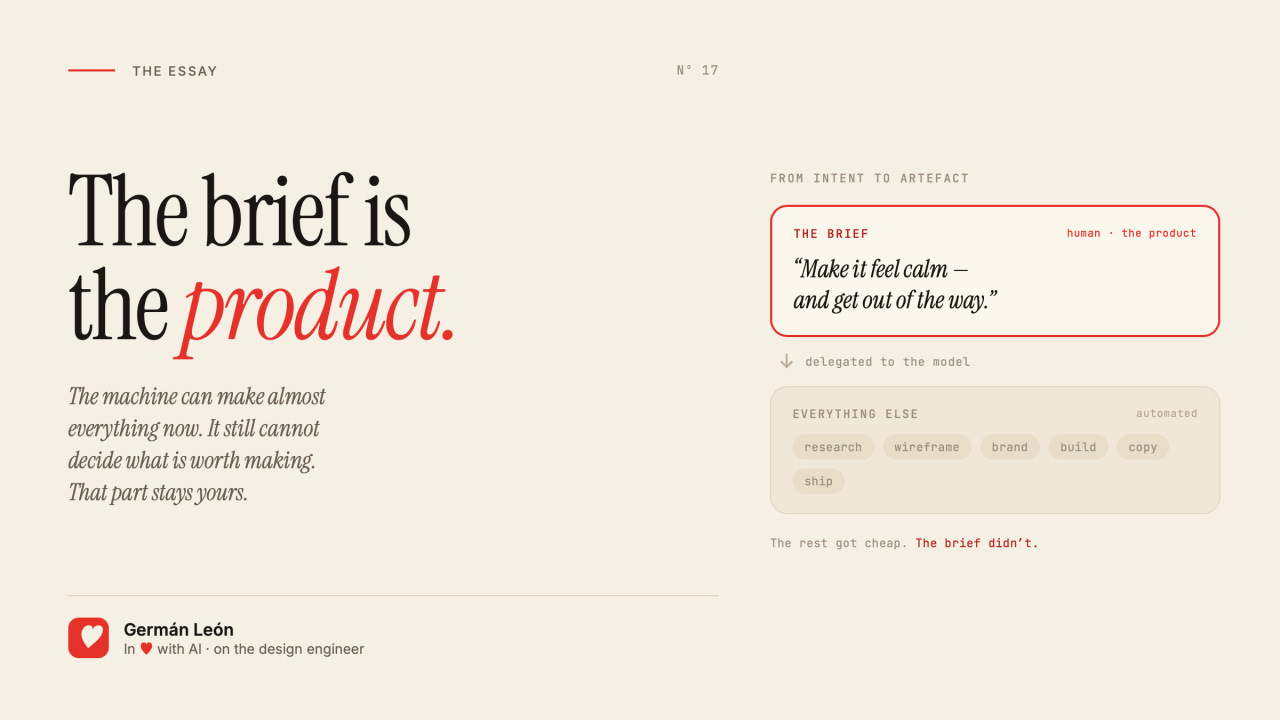
This is what I mean when I say the brief is the product. The quality of the instruction is where differentiation lives now.
Mollick’s March piece, The Shape of the Thing, describes the current AI moment as a shift from “co-intelligence” , humans prompting AI back and forth, to managing AI agents that you can hand hours of work to and get results back in minutes. He calls it a “rolling disruption”: capabilities crossing thresholds unpredictably, unlocking radical new use cases sometimes overnight, with organizations that figure out a good way to work with AI now setting the precedent for everyone else.
The window to shape how these tools get used is open. It won’t stay open.
What I find interesting about where we are right now is that design engineers are uniquely positioned for this moment, and uniquely at risk. The position is valuable because design has always required holding intent and execution simultaneously, and that’s exactly the skill an agentic workflow demands. The risk is that the speed of execution makes it seductive to skip the hard part. Generate fast, ship fast, iterate. The brief gets looser. The judgment atrophies.
Linas puts the builder’s version of this bluntly: “Taste and judgment become moats. When anyone can generate code, differentiation comes from knowingwhat not to build, what good looks like, and when to stop.”
That’s not a description of a technical skill. It’s a description of a design sensibility. And it’s the thing that can’t be delegated to the agent.
I’ve been watching what the third cohort at our MHIAI program has been building toward their graduation show this month, and what strikes me is how much of the most interesting work is happening in the brief-writing layer. Not in the models, not in the interfaces — in the act of describing, precisely, what an intelligent system should do, for whom, and under what constraints. That’s where the real intellectual work is. That’s where trust gets built or lost.
If the accountant’s value proposition is shifting from executing reconciliations to writing clear briefs for agents that execute them, and if the same shift is happening in every professional domain that AI touches, then what design engineers have always known how to do becomes the most portable skill in the room.
The question I’m sitting with: if the brief is the product, how do we train people to write better briefs? And what do we lose if we let the AI write those too?
Sources:
Linas Beliūnas, “The Day the AI Builders Felt Behind”, December 2025
Linas Beliūnas, “Ramp Stack Gives Accountants Free AI Agents”, June 7, 2026
Ethan Mollick, “Choosing to Stay Human”, May 26, 2026
Ethan Mollick, “The Shape of the Thing”, March 12, 2026