


There is a moment that happens somewhere in the middle of building something new, when the gap between what you can imagine and what you can actually make feels unbridgeable. For most of design history, that gap was filled by a handoff: the designer sketched the idea, the engineer built it, and somewhere in the translation, something was always lost. An intention softened. A nuance dropped. A human feeling flattened into a specification.
Artificial intelligence has blown that gap wide open, and with it, an entirely new kind of professional has begun to emerge. Not a designer who codes a little. Not a developer who cares a bit about UX. Something genuinely new: a professional who can conceive of an intelligent system, understand the cognitive science behind how humans will interact with it, and then actually build it, prototype it, test it, and ship it.
They go by many names in the industry. Product AI designer. Human-AI interaction specialist. AI-native builder. But at ELISAVA Barcelona School of Design and Engineering, we have been training this professional with intention and rigour for three consecutive cohorts now, under the name the Master in Human Interaction and Artificial Intelligence (MHIAI).
On June 16th, 2026, the third generation of these professionals will walk off the stage at their graduation show and into a world that is only beginning to understand what they represent.
The Idea That Started It All
I have spent my career living at exactly this intersection, watching projects collapse in the white space between a Figma file and a Python notebook, seeing brilliant AI systems fail not because the model was wrong, but because no one designed the moment of human contact.
The MHIAI was built to close that gap permanently.
“Artificial intelligence is no longer just an occurrence of science fiction,” the programme states. “It surrounds us, making our lives easier. Our challenge now is adapting it to ever-evolving new business and human needs, with social and environmental responsibility.”
The curriculum moves through seven interlocking modules: an introduction to AI and interaction design; the design and development of actual interactions (including code); the fundamentals of cognitive science; machine learning and neural network models; user experience architectures; principles of AI; and finally, a master’s thesis that is not a paper but a living, working AI product, presented in public.
What a Design Engineer Actually Does
The title “Design Engineer” is still fighting for its place in the corporate org chart. Recruiters paste it into job descriptions, then back-fill the role with either a graphic designer who has learned to use ChatGPT or a software engineer who has taken a weekend UX course. Neither is close.
A true Design Engineer in the MHIAI mould is someone who can do four things simultaneously that the industry has historically treated as entirely separate:
First, they understand people. Cognitive science is not an elective in this programme; it is a load-bearing pillar. Students learn how humans form trust with systems, how perception and memory constrain interface design, and how emotional responses shape interaction patterns. They read Nathalie Nahai‘s work on web psychology. They wrestle with the ethics of persuasive design. They learn to ask not just “does this work?” but “does this treat the person using it with dignity?”
Second, they understand machines. Not at the level of implementing production-grade LLM infrastructure, but deeply enough to know what machine learning models actually do, how neural networks arrive at their outputs, where hallucination comes from, and why a system trained on one population behaves unexpectedly with another. When a designer understands why a model fails, they design for that failure. When they do not, they are just drawing pictures on top of a black box.
Third, they can build. The programme is unambiguous about this. Students work with Python. They work with JavaScript. They build high-fidelity prototypes that are not click-through mockups but actual functioning intelligent systems. The Final Master Project is a real AI product, not a concept deck. The graduation show is not a portfolio review but a live demonstration.
Fourth, they think entrepreneurially. This is perhaps the quality that most surprises faculty and industry mentors alike, and it is the quality that defines the third graduating cohort most powerfully. These are not students waiting to be placed inside a company. They are founders in waiting, or in several cases, founders already.
The Third Generation: A Cohort Portrait
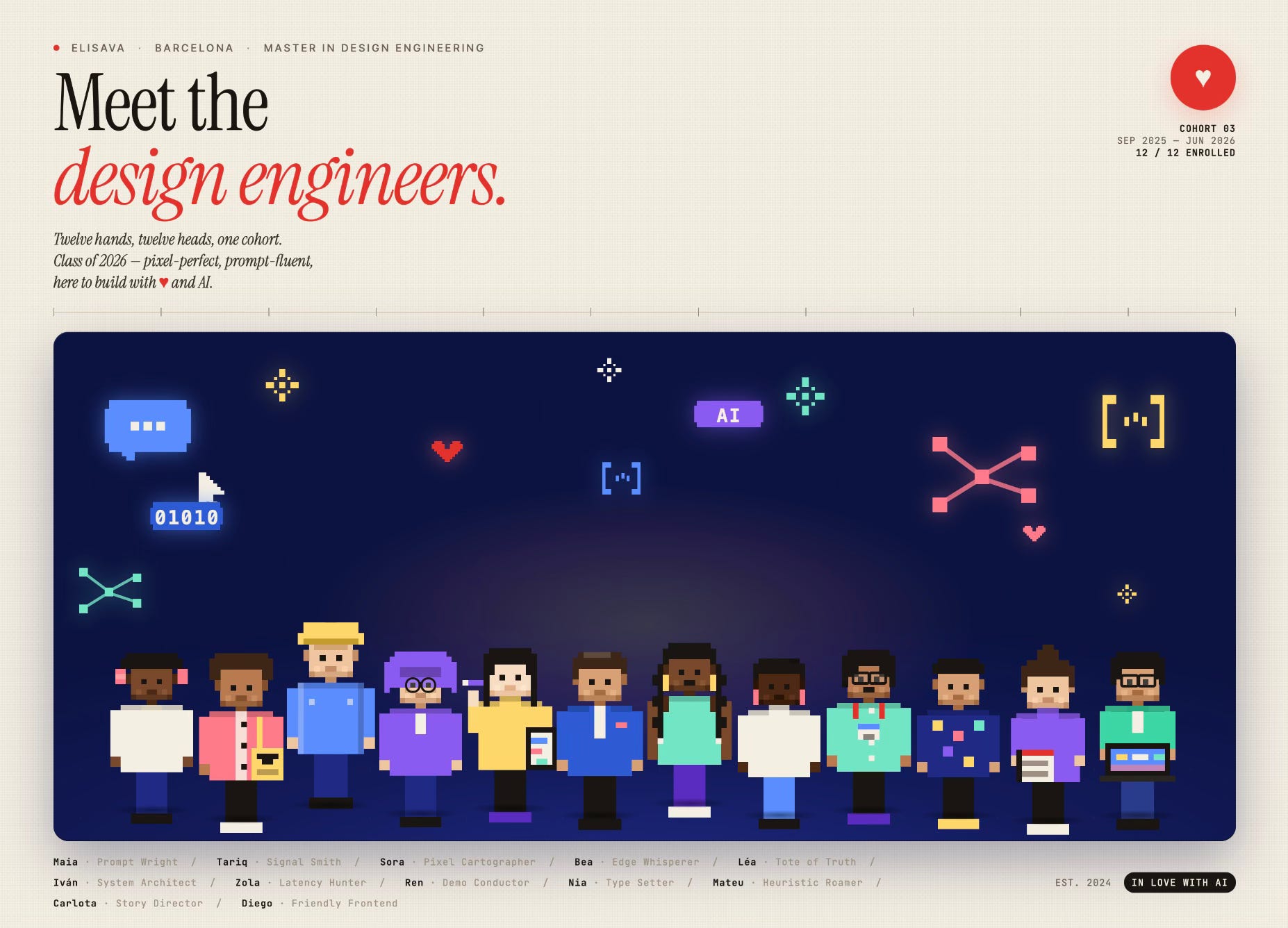
Twelve students. Look at where they come from: Greece, Italy, Brazil, Portugal, the Philippines, Singapore, China, and the United States. Eight countries, twelve people, one programme. For a cohort this small, the geographic spread is remarkable, and it is entirely deliberate.
The diversity is not incidental. It is the syllabus. When Nikos Bellos Bellos from Greece sits next to Wing Ren from Wenzhou, China, and both attempt to design an AI interaction that works for both of them, something happens that no monoculture classroom can replicate. Assumptions surface. Edge cases multiply. The design space expands. The AI gets better because the humans making it are more varied.
Let us meet some of the people who will be presenting their final projects on June 16th.
Nikos Bellos - Athens, Greece
Nikos is what happens when a multidisciplinary engineer refuses to pick a lane. Trained across computer systems and design at the National Technical University of Athens, with 500+ professional connections and an established presence in the European tech ecosystem, he arrived at ELISAVA already fluent in the technical grammar of intelligent systems. What the master gave him was the human vocabulary to go with it.
Where many engineers treat design as a final coat of paint applied to something that already works, Nikos came to understand design as the primary material of an AI product, the substance from which the user’s trust is either built or denied. Watch for a final project that sits at the precise boundary between engineering rigour and interaction poetry.
Izaskun Cuenca - Lisbon, Portugal
Based between Lisbon and Barcelona, Izaskun carries the particular perspective of someone who has lived across Iberian cultures and understands how language, geography, and social expectation shape the way people relate to technology. AI systems trained on US or UK data frequently misfire for European users in ways that are invisible to their designers. Izaskun sees those misfires coming.
Her presence in the cohort represents something the programme prizes above almost everything else: the designer who brings genuine ethnographic curiosity to every brief, who asks what the user’s life actually looks like before asking what the screen should look like.
Beatrice Delucchi - Genova, Italy
Beatrice brings the Italian tradition of craftsmanship into a domain that often trades precision for speed. From Genova, a city with a long history of engineering excellence, she approaches AI product design the way a shipwright approaches a hull: every element serves a function, nothing is gratuitous, and beauty and utility are not in tension but in conversation.
Her LinkedIn presence, already established before graduation, reflects a professional who understands that design is a public act of communication as much as a private act of problem-solving. She makes things that hold up.
Ana Fellipelli - São Paulo, Brazil
Ana came to ELISAVA carrying serious industry weight. Before the programme, she had already worked across Autodesk, Ericsson, and Globant, scaling design systems across more than 20 SaaS products and partnering with engineers and product managers on platforms used by hundreds of thousands of people. She knows what design at scale actually costs, and what it takes to maintain coherence when the system is large enough to fight back.
What the master added was the technical literacy to understand the intelligence layer underneath the interface: why a model behaves the way it does, how that behaviour shapes the user’s experience, and what the designer’s responsibility is when the system learns. She arrives at the graduation show as someone who can design the full stack of the human-AI relationship, not just the surface of it.
Lyla Huang - Singapore
Yanling brings to the programme the particular sharpness of someone trained in one of Asia’s most demanding digital ecosystems. Singapore has spent decades building AI governance frameworks, public digital infrastructure, and a culture where technology is expected to work properly for everyone, not just for early adopters. That expectation is a design standard, and Yanling carries it.
In a cohort full of people who can build things, she stands out for her attention to what happens after the thing is built: how it is governed, how it adapts over time, how it survives contact with real users in conditions that were never part of the design brief. That long-view sensibility is exactly what most AI products lack, and most teams struggle to hire for.
Samantha Lin - San Francisco, USA
Growing up in San Francisco means growing up inside the technology industry’s self-image. Samantha has seen what happens when products are shipped fast, and the human cost is discovered later, when the gap between what a system can do and what it should do gets papered over with another product update.
The MHIAI gave her a different frame entirely: one in which the design of the interaction is not a layer applied on top of the technology but the technology’s most important feature. She brings to the graduation show a designer’s rigour and a San Franciscan’s hard-won scepticism, a combination that produces work that is both ambitious and honest about its own limitations.
Denise Macalino - Canada
Denise is building AI products with a design conscience that most of the industry has not yet developed. Her focus is not on what these systems can do in ideal conditions but on what they do when the conditions are not ideal, which is most of the time, for most of the world.
She asks the questions that do not appear in the standard UX playbook. What happens to an AI interaction when the connection drops? How does a voice interface behave when it was not trained on your language? What trust does a system earn, or destroy, in the first thirty seconds with a user who has never encountered anything like it before? These are not edge cases. They are the experience of the majority of the planet, and Denise designs for them with the conviction of someone who has lived it.
Tin Manasan - Philippines
Tin, as she is known in the programme, is one of those designers who understands that cultural fluency is a technical skill. Growing up navigating multiple languages, multiple platforms, and a digital culture that is simultaneously local and deeply global, she developed an instinct for the gaps that AI systems fall into when they are built by people who only know one context.
At ELISAVA, that instinct became a methodology. She can identify, at the prototype stage, where an intelligent system will fail to read a user correctly, not because the model is broken but because the model was never introduced to that user’s world. Her final project takes that problem seriously, designing not just around it but through it.
Tommaso Quintiliani - Rome, Italy
Tommaso carries the weight and the gift of coming from Rome, a city that has been building things designed to last for three thousand years and has therefore developed a deep scepticism toward anything that is merely fashionable. He applies that scepticism to AI products with productive results.
Where many in the cohort are drawn to the frontier of what AI can do, Tommaso is equally interested in what it should not do. In the language of the programme, he is thinking about trust, explainability, and the ethics of automated decision-making not as constraints on design but as design materials in their own right.
His LinkedIn profile, already live on the Italian professional network, marks him as someone who takes the public dimension of design seriously. Work is not private until it ships. It is public from the moment it affects someone.
Wing Ren - Wenzhou, China
Wenzhou has a reputation in China that is almost mythological: a city that built itself through private enterprise when there was barely a framework for private enterprise to exist, producing generations of people who know how to move fast, adapt relentlessly, and build things that survive. Wing carries that inheritance into her design work, and it shows.
She is a builder in the t@ruest sense: someone for whom an idea is not finished until it is a thing that works in the world and has been tested against the friction of real use. At ELISAVA, she combined that drive with a rigorous understanding of human-AI interaction, producing work that is entrepreneurially ambitious but technically grounded. She is one to watch well beyond June 16th.
Nona Voss - Düsseldorf, Germany
Nona brings one of the most distinctive perspectives in the cohort: she arrived at AI interaction design not through the front door of design or engineering but through a path that kept her close to the human side of the equation. The result is a professional who never lost sight of what these systems feel like to someone encountering them for the first time.
That might sound like a modest skill. It is not. Most AI products are built by people who find them intuitive, for users who do not. The gap between those two groups is where adoption fails, trust breaks down, and expensive systems sit unused. Nona fills that gap with precision. She asks what a system needs to communicate about itself before a user will risk trusting it, and she builds those answers into the interaction from the ground up.
Rene Zelaya - San Francisco, USA
Rene has watched the technology industry redefine what a career looks like several times over, and he has developed a hard-won immunity to hype. He has seen the pattern: breathless launch, scaling crisis, user trust collapse, quiet rebuilding. He knows where in that cycle most AI products currently sit, and he designs with that knowledge in the room.
His work at ELISAVA is focused on the question that most AI product teams avoid until it is too late: what does the relationship between a person and an intelligent system look like, not at launch, but six months in? A year in? How does trust accumulate, and what destroys it? These are not abstract questions for Rene. They are the design brief. Any team building an AI product that expects to still have users in two years needs someone asking exactly these questions from day one.
The Graduation Show: June 16th
Every cohort of the MHIAI has ended with a public demonstration, and the tradition has grown more ambitious with each iteration. The first generation introduced the format; the second refined it at the Roca Gallery Barcelona, one of the city’s most architecturally considered cultural spaces. The third generation is expected to go further still.
What visitors to the June 16th show will encounter is not a portfolio exhibition in the conventional sense. It is closer to a product launch, except that the products are AI systems, and the demonstration is done live, in real time, in conversation with real people.
This is intentional and important. An AI product that only works in the controlled conditions of a design studio is not an AI product; it is a proof of concept. The graduation show is the first public test. How does the system behave when confronted with someone it did not expect? How does it recover? How does it invite the user to trust it, and does it earn that trust?
These are the questions that the third generation has been building toward for a full academic year. The answers will be on display on June 16th.
Demo Day: June 25 and 26 - Live, Global, Unmissable
The graduation show is just the beginning. On June 25th and 26th, the third cohort takes the stage again for Demo Day, and this time, the room has no walls.
Both days will be streamed live, open to anyone in the world who wants to watch what happens when a group of extraordinarily trained Design Engineers unleashes their final AI products in front of an audience of investors, industry judges, and professionals tuning in from across Europe, Latin America, Asia, and the United States.
This is not a student showcase. It is a product demonstration in the fullest sense: twelve AI systems, built from scratch, presented by the people who conceived and built them, evaluated by people who have seen a great many AI products and know the difference between something real and something that merely looks real.
For investors, it is an early window into some of the most original AI product thinking currently coming out of European design education. For hiring managers, it is a live skills assessment more honest than any interview. For anyone working at the frontier of human-AI interaction, it is simply the most exciting thing happening in those two days.
Mark June 25th and 26th in your calendar. Set a reminder. Share the stream. The cohort has spent a year building something worth watching.
Why This Matters Beyond Barcelona
It would be easy to frame the MHIAI as a Barcelona story, a European story, a design school story. It is all of those things. But the professional it is producing is not local.
The Design Engineer is emerging simultaneously and somewhat independently in design schools and tech companies across the world, because the world needs them urgently. Every organisation that has deployed an AI system and watched it fail to achieve adoption has encountered the problem that the MHIAI was created to solve. The gap between what the model can do and what the person will trust it to do is a design problem. It requires someone who understands both sides of the gap and can bridge them with intention.
The roles exist and are unfilled in every sector: healthcare, finance, education, logistics, retail, and government. The job titles keep shifting because organisations have not yet settled on what to call someone who can do all of this at once. Human-AI Interaction Designer. AI Product Designer. Conversational Systems Designer. Intelligent Experience Lead. Whatever the title on the requisition, the underlying need is identical: someone who can design an AI product that real people will actually use, trust, and return to.
But what job descriptions cannot quite capture is the entrepreneurial dimension that has come to define this cohort. The first two generations produced professionals who went into companies and reshaped them from the inside. The third cohort looks, from the inside, like it will produce companies of its own.
When you put twelve people from eight countries in a room and teach them to build AI products with cognitive rigour and ethical seriousness, something happens. Collaborations form. Shared obsessions crystallise into ideas. Ideas that one person would have abandoned as too ambitious become feasible when someone else knows how to build the piece they cannot. The graduation show is as much an opportunity for investors and hiring teams as it is an academic milestone.
What You Are Actually Hiring
If you are a recruiter, a hiring manager, or a founder reading this, here is the direct version.
These twelve graduates can do something that most job candidates in the current market cannot: they can take an AI product from concept to working prototype, understand why it will or will not be trusted by the people who use it, and design the interaction so that trust is built from the first contact rather than retrofitted after the first complaint.
They are not generalists who have added “AI” to their LinkedIn headlines. They have spent a full academic year inside the problem, working with machine learning models, building functioning interactive systems in Python and JavaScript, studying the cognitive science of human-machine interaction, and presenting their work publicly to industry professionals who have no obligation to be kind.
They are multilingual, multicultural, and radically pragmatic about what AI can and cannot do for people. They have been trained by practitioners from Autodesk, Hubtype, Futurity Systems, Blackbot, and GFT, among others, not by academics describing an industry from a distance.
The specific skills they bring to a team:
Designing AI-driven interfaces and conversational systems that users trust from the first interaction. Prototyping intelligent systems using real code, not just mockups. Conducting user research specific to AI contexts, including how people form mental models of systems that learn and adapt. Identifying where AI models will fail for specific user populations before those failures reach production. Thinking about AI products across their full lifecycle, including adoption, trust degradation, and recovery.
If your organisation is building anything with AI and you are struggling to find people who can sit comfortably at the intersection of design, technology, and human behaviour, these are the people you are looking for.
They graduate on June 16th. They are available now.
The Faculty That Made It
It would be incomplete to celebrate the cohort without acknowledging the faculty who shaped them.
I teach Introduction to Artificial Intelligence and Interaction Design myself, and my approach sets the tone for the entire programme: professionals teaching what they actually do, not what they read in a textbook. Beside me, Gemma Alcodori León develops the character and executive presence that no technical curriculum alone can build, Arcadi Poch unlocks creative thinking and makes generative AI feel like a natural extension of the imagination, and Tim Cowlishaw brings a rare combination of deep coding fluency and interaction design sensibility that only comes from years of building real things. Victor Ventura teaches the UX architecture module with Figma at its centre, turning abstract product thinking into decisions students can see, test, and defend. Andrea Talal Haidar, from Hubtype, teaches conversational design with the authority of someone who has deployed chatbots in production environments that handle millions of conversations.
Regina Dos Santos Estevez teaches cognitive science and design fundamentals, and her influence is visible in the cohort’s unusual sophistication about the human dimensions of intelligent systems. Cecilia MoSze Tham of Futurity Systems teaches AI principles through the lens of speculative design and future thinking, pushing students to ask not just what AI can do today, but what kind of world it should be building toward. Fernanda Rocha and Jon Black from Blackbot bring a studio energy to creativity and design thinking that makes the room feel less like a classroom and more like a place where ideas get made. Stephanie Rodriguez Osorio, Jonatan Poveda Pena, and Pelayo Méndez Flórez form a teaching trio that gives machine learning its practical backbone, connecting theory to the decisions real ML practitioners make every day. And Ariel Ortiz Beltrán, Ph.D., closes the ML arc with the rigour and depth that only a researcher who has lived inside the field can offer.
A staff that reads less like a university faculty and more like the board of advisors a well-funded AI startup would kill to assemble.
This is not accidental. It is the programme’s fundamental pedagogical bet: that the best way to train people to work in an industry is to have the industry teach them.
The Larger Argument
There is a debate running through the design and technology industries right now about whether AI is going to make designers irrelevant or make them more powerful than they have ever been. It is, as most binary debates are, the wrong question.
The correct observation is this: AI is making some kinds of design work trivially automatable, the repetitive, the formulaic, the execution-heavy, while simultaneously creating an enormous demand for a kind of design work that has barely existed before: the intentional, the trust-building, the human-centred design of intelligent systems themselves.
The MHIAI graduates stepping onto the stage on June 16th are not threatened by the first category. They are the answer to the second one.
They are the professionals who understand that when someone interacts with an AI system, they are doing something fragile and human: making themselves legible to a machine, trusting that it will not distort or dismiss what they offer. They are the professionals who know that designing that moment of contact, with all of its cognitive, emotional, and ethical complexity, is the most consequential design challenge of the current decade.
Three generations in, the MHIAI has demonstrated that this professional can be trained, and that once trained, they go on to build remarkable things. The graduation show is where that proof goes public.
On June 16th, twelve members of the third cohort, from São Paulo to Singapore to San Francisco to Rome to Wenzhou to Athens, will stand up in Barcelona and show the world what they built.
If your organisation builds anything with AI, you should be in that room.
The 3rd MHIAI Graduation Show takes place on June 16th, 2026, at ELISAVA Barcelona School of Design and Engineering, La Rambla 30-32, Barcelona. Demo Day streams live on June 25th and 26th, 2026, open to a global audience.
The title is new, the shift isn’t. The designers who got dangerous are the ones who stopped writing specs and started shipping the actual thing. AI didn’t create this role, it just killed the excuse to hand off and wait two sprints. The taste still has to come from somewhere though.