


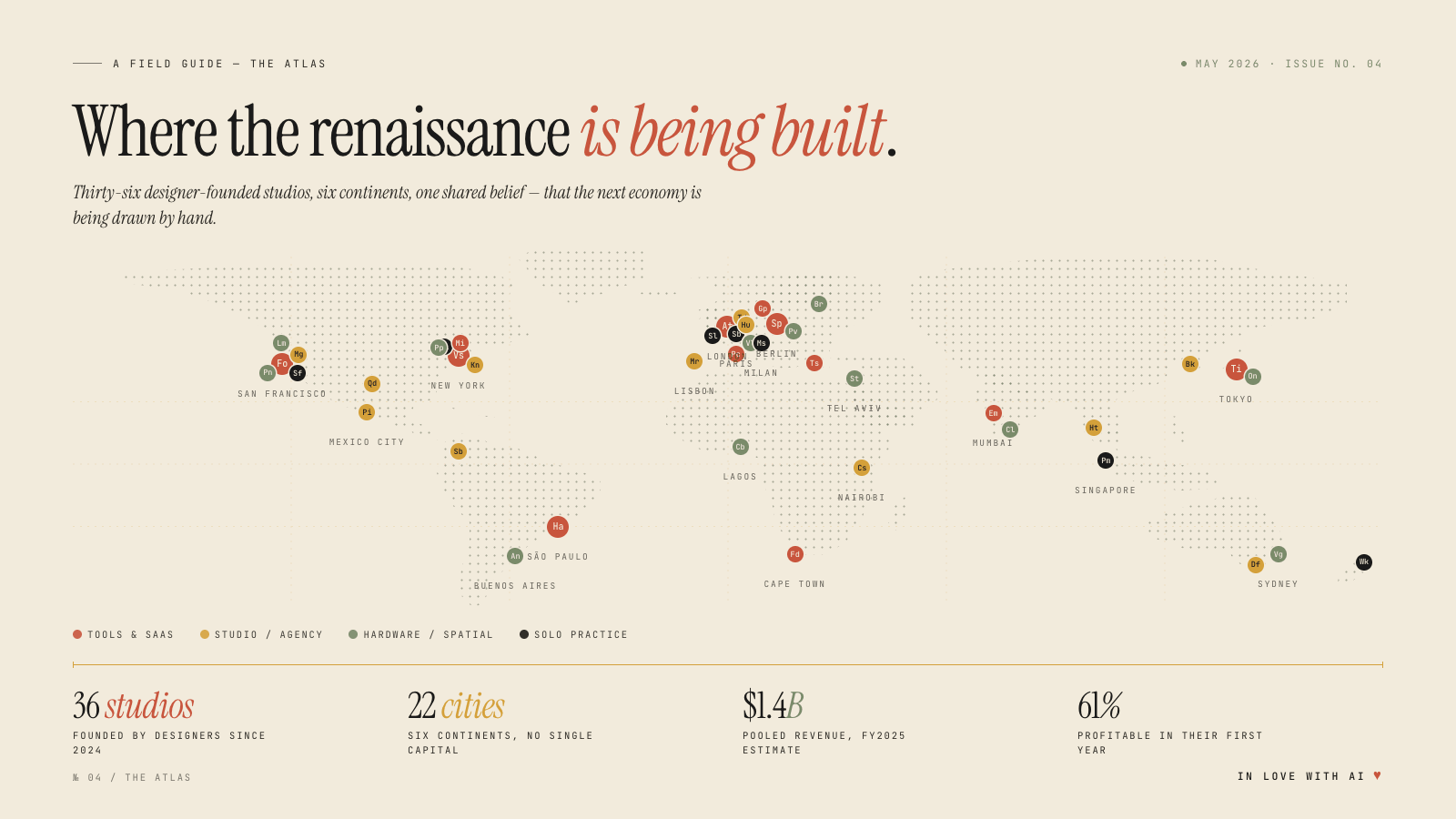
Three weeks ago, I was teaching a class in Barcelona, and a student raised her hand to ask a question that has been quietly eating designers alive for two years: “Why would I spend three years climbing into a senior UX role at a Fortune 500 when half of them are firing the designers they already have?”
It was the right question. But it was the wrong frame. Because the same week that question got asked, a 28-year-old designer with no engineering background was selling her solo design tool to Wix for eighty million dollars, and a designer-founded company called Figma was trading at a sixty-eight billion dollar valuation on the New York Stock Exchange.
The corporate door is narrower than it has ever been. The door to building your own thing has never been wider. We are in a renaissance, and most designers haven’t noticed yet because they are still looking at the wrong door.
The Layoff Data Looks Brutal. Because It Is.
Let me put the bad news on the table first, in numbers, so we are not pretending.
Tech layoffs in Q1 2026 hit 52,050 cuts, a 40% jump over the same period in 2025, and the highest first-quarter total since 2023. As of mid-year, 144,355 tech employees have been laid off, roughly 982 people per day. Since 2022, more than half a million tech workers have lost their jobs. Meta opened 2026 by cutting 1,500 from Reality Labs. Amazon has cut roughly 16,000 roles cumulatively this year. Oracle ran the single largest reduction event of the year in late March.
The design-specific numbers are no kinder. Across 5,521 analysed tech layoffs, UX roles accounted for 8.7% of the cuts, far above their share of total headcount. UX designer job postings fell 71% from their 2022 peak. One in three organisations cut UX staff in 2024, the worst year since Nielsen Norman Group started tracking the field. In October 2025, Google laid off more than 100 design and UX research roles from its Cloud division in a single week. 44% of hiring managers in a recent survey said AI is a top driver of the cuts.
If you are a senior UX designer at a Fortune 500 right now, the floor under your role is shaking. That is not a vibe. That is the data.
But the data has two sides, and the second side is the one nobody is putting on the same page as the first.
The Designer-Led Renaissance Is Happening in Plain Sight
While the Fortune 500 was cutting designers, designers were quietly building the companies that are eating those Fortune 500s.
Start with the headline. On July 31, 2025, Figma went public at $33 a share. By the end of day one, it was trading at $115.50, a 250% pop, valuing the company at roughly $68 billion. Q1 2025 revenue was $228 million, up 46% year over year, with $44.8 million in net income. The founder, Dylan Field, 33 years old, a college dropout, started the company on a Peter Thiel fellowship grant and is now worth around $6.6 billion. Figma is, at this point, the most successful designer-led company in the history of the internet.
It is not alone. Canva has 185 million users and $2 billion in revenue. Webflow has 4 million users and $314 million in revenue, combining visual design with production code. Both are designer-led. Both were “too niche” when they started. Both now sit on top of the workflows that the Fortune 500 design teams were paid six figures to perform manually.
That is the top of the market. The bottom of the market is, if anything, more telling.
Maor Shlomo built Base44, a solo product, to 250,000 users and profitability in six months, then sold it to Wix for $80 million in June 2025. Danny Postma’s HeadshotPro, run solo, generates $3.6 million in annual recurring revenue. Sarah Chen launched an AI-powered design agency in January 2025 using ChatGPT Plus, Canva Pro, and Zapier, and hit $420,000 in annual revenue within eight months, working 25 hours a week. Jason Zhou’s Superdesign is bootstrapped, designer-led, and generating UI mockups, components, and wireframes from natural-language prompts.
The structural numbers underneath these stories are the part that matters most. AI-augmented founders ship 8 to 12 features per month, versus 2 to 4 for non-AI founders. Cursor crossed 1 million monthly active users in early 2026. 34% of new micro-SaaS products launched in Q1 2026 were built by founders with no prior programming experience, several of them generating $5K to $50K in monthly recurring revenue. Solo-founded startups grew from 23.7% of all new companies in 2019 to 36.3% by mid-2025. There are now 41.8 million solopreneurs in the U.S., contributing $1.3 trillion to the economy annually.
This is not the data of an industry in decline. This is the data of an industry that has stopped needing the old gatekeepers.
What Actually Changed (And Why It Favours Designers)
Let me be precise here, because this matters.
For most of the last twenty years, a designer with a product idea had to assemble a team to ship it. A frontend engineer. A backend engineer. A devops person. A PM, eventually. A marketer. Each of those people cost money, slowed down decisions, and demanded equity. The cost of going from “I see the product clearly in my head” to “real users are using it” was, in practical terms, prohibitive for one person.
That cost just collapsed.
A designer in 2026 can prototype in Claude or Cursor, deploy with Vercel or Lovable, run payments through Stripe, do support with Intercom or a tuned model, generate marketing assets in Canva or Midjourney, write copy in Claude, and reach a million people through TikTok, X, LinkedIn, or Substack without buying an ad. The five-person team a designer needed in 2019 to ship a product is now the designer, alone, on a Tuesday afternoon.
The thing that was always the designer’s edge, taste, judgment, knowing what users actually need, has never stopped mattering. What changed is that the things that used to bottleneck the designer (engineering, deployment, distribution, ops) are now solvable with the tools the designer already lives in.
This is what the Fortune 500 layoffs are quietly telling us, and what almost nobody is reading correctly. The cuts are not happening because design doesn’t matter. They are happening because the work that used to require 50 designers in a corporate org now requires 3 designers and the right stack. The 47 designers who got cut do not have to go become baristas. They can go become founders. Many of them are.
Why I Am Calling This a Renaissance
The word “renaissance” gets used loosely. I want to use it precisely.
A renaissance occurs when the gap between what an individual can imagine and what they can produce collapses. The original Renaissance was, in large part, a story about tools: the printing press, perspective in painting, oil paints, and anatomy. Tools that let one person, sitting in a workshop, produce work that previously required institutional infrastructure. The artists did not become more talented in 1500 than they had been in 1400. The cost of expressing their talent simply fell through the floor.
That is exactly what has happened to designers in the last 36 months.
For the first time in the history of the field, a designer with taste, judgment, and the discipline to ship can:
Build the prototype themselves, in code that runs
Deploy it to real users in an afternoon
Get feedback from those users the next morning
Iterate the design and the system simultaneously
Reach an audience of millions without a marketing department
Charge those users money without an accounts team
Run the whole operation, solo, for under $500/month in tooling
This was true for almost nobody in 2019. It is true for almost everyone with the discipline to try in 2026.
The designers who are still measuring their success by “did I get the senior IC promotion at the Fortune 500” are looking at the wrong yardstick. The renaissance is not happening inside the orgs that are cutting. It is happening at the kitchen tables of the designers who left them.
The Real Question Isn’t “Are Designers Being Replaced?”
The real question is: what kind of designer are you choosing to be?
If you are a senior UX designer at a Fortune 500 with a stable role: enjoy it, but understand that the floor is shaking and the ladder above you has fewer rungs each quarter. Use the stability to learn the new stack. Don’t wait until your role is the one being cut to start.
If you are a mid-career designer recently laid off, the data says you are not alone, and the data also says the door you should be looking at is not the next big tech job. It’s the product you have wanted to ship for three years and kept postponing. The cost of trying is now under $500.
If you are a junior designer entering the field, the corporate ladder is the worst it has been in a decade. The solo-builder path is the best it has ever been. Pick accordingly. Do not optimise for the role the previous generation had. Optimise for the role that did not exist five years ago.
If you are a design leader running a team: smaller teams are now structurally more productive than larger ones for almost everything below the largest enterprise scale. The teams of 30 you used to need are teams of 5 with the right tools. Plan accordingly.
If you are a founder thinking about a first design hire: hire one designer who can also ship, not three designers who pass work between them. The designer who can prototype in code is now worth what three traditional designers used to be.
The future isn’t “every designer becomes a solo founder”. It is “the floor of what one designer can ship has risen by an order of magnitude, and the designers who internalise that early will be the ones building the next generation of products”. Some of them will be solo. Some will be at startups of three to ten. Some will be inside big companies that figured out how to give designers leverage instead of cutting them. All of them will be operating in a fundamentally different game than the one that ended in 2022.
Why This Matters Right Now
For most of the last fifteen years, the most important question a designer could ask was “how do I get into the right team at the right company?” The answer was a portfolio review, a system case study, and a willingness to wait two years for a senior promotion that would unlock the projects you actually wanted to work on.
That game is ending. Not because designers are losing power, but because the lever has moved.
A year ago: a designer with an idea wrote a spec, recruited an engineer friend, lost three months to scope creep, shipped a half-version of the product, ran out of energy, and never told anyone.
Today: a designer with an idea prototypes it in Claude over a weekend, ships it to a Vercel domain on Sunday night, posts a demo video on Monday, gets 10,000 views by Wednesday, has paying users by Friday, and is iterating on the system based on real user behaviour by the following Monday.
This is not a small shift. It’s a complete inversion of which side of the design profession holds the power.
If You Want To Stay Ahead
The designers who will look back on 2026 as the year their career compounded are not the ones waiting to see if the layoffs slow down. They are the ones who used the chaos to stop asking permission.
How do you ship a real product solo, with no engineering team, in 2026? How do you find your first 100 paying users without an ad budget? How do you build a design tool that 50,000 other designers want to use? How do you turn a portfolio of unshipped concepts into a portfolio of products with revenue? How do you stop optimising for the next role and start optimising for the next thing you make?
These are new skills. And like every new skill in design history, the people who learn them early have an outsized advantage over the people who wait until they are the default.
The designers who learned Figma early didn’t get rich because of Figma. They became impossible to compete with on iteration speed. The designers who learn to ship full products solo in 2026 will look back, in three years, the same way.
The Bottom Line
The layoffs are real. The fear is real. The shaking floor at the Fortune 500 is real.
The renaissance is also real, and it is structurally larger than the layoff wave. Figma’s $68 billion IPO, Base44’s $80 million acquisition by Wix, Canva’s $2 billion revenue, the 34% of new micro-SaaS products built by non-coders, the 41.8 million solopreneurs adding $1.3 trillion to the economy: these are not isolated stories. They are the shape of the new game.
In 18 months, the question won’t be “will my Fortune 500 design job survive?” It’ll be “why didn’t I start shipping my own thing two years ago when the tools first made it possible?”
That shift is already happening. The designers who started this month are already ahead of the ones who waited.
Germán Dario León Osório
In Love With AI
P.S. If this resonates, you are probably the type of designer who has been telling yourself “I’ll start that product when I have more time / more savings / more permission”. You don’t need any of those. You need a weekend, a Claude subscription, a Vercel account, and the willingness to ship something publicly imperfect on a Monday morning. The renaissance is not waiting for anyone. The people I see thriving in it are the ones who stopped asking what their company’s next move is and started making their own.
Sources
2026 Tech Layoffs Tracker: 52,050 Q1 Cuts + Where Talent Lands (Kore1)
Tech Layoffs: US Companies With Job Cuts In 2024, 2025 and 2026 (Crunchbase News)
The AI layoff wave is just beginning, and it’s by design (Fortune)
The AI Layoff Crisis of 2025: Why 70% of UX Designers Will Be Replaced (Medium)
UX Designer Job Postings Are Down 71%. Figma Filed for a $68B IPO. (Medium)
State of UX 2026: Design Deeper to Differentiate (Nielsen Norman Group)
Figma shares more than triple in soaring public debut (Fortune)
Figma’s Blockbuster IPO Gives CEO Dylan Field a $6 Billion Fortune (Bloomberg)
Solo Founder Index 2026: Success Rates, Tools, and the AI Advantage (ShipSquad)
Solo founders are using AI to do the work of entire teams (Fortune)
7 Solo Founders Building $1M+ AI Businesses in 2026 (Grey Journal)