


The most important AI + UX news this week
Figma grew 48% while the industry cut the people who use it. On Tuesday after markets closed, Figma reported Q2 revenue of $370.1 million, up 48% year over year, its third consecutive quarter of accelerating growth. Net dollar retention hit 136%, customers spending over $100K grew 46%, and the company raised full-year guidance by $40 million to roughly $1.47 billion. The number that matters most for this newsletter is buried lower: over 80% of paid customers above $10K in ARR now consume AI credits every single week, and more than half use the Figma Agent weekly. AI is not a feature Figma bolted on. It is now the engine of the revenue acceleration. Why it matters for practitioners: the business model of design tooling is quietly shifting from seats (paying per human) to credits (paying per unit of capability). Watch what your own company meters, because that is what it will optimize.
The other column of the ledger. The same week, AI-attributed job cuts led all stated layoff reasons in the US for a fourth consecutive month. Through June, AI had been cited in 101,743 US job cuts, nearly double the total for all of 2025. Tech companies eliminated 139,156 workers in the first half, up 83% year over year, while committing roughly $700 billion to AI infrastructure. Meta cut about 8,000 people and moved roughly 7,000 into AI-focused roles in the same motion, which is the whole story in one org chart. Hold this next to Figma’s quarter and the contradiction dissolves into something more precise: companies are not spending less on making software. They are re-routing the spend from producing to directing. The essay below is about what that means for your job.
Product launches and interface innovations
Meta shipped its first coding agent, and it lives in a terminal. Muse Code launched on August 5, Meta’s first AI coding agent, priced to undercut Anthropic and OpenAI, and operated through a single terminal interface. Set the price war aside. The interface choice is the news. The most contested product category of 2026 keeps converging on a command line, and there is a reason (see the research section).
Google’s Gemini Spark works while your laptop sleeps. A $99.99/month cloud-based agent, included in the AI Ultra plan, that keeps executing when your device is off. The design question it raises is one nobody has good patterns for yet: what does the morning-after interface look like? When a user returns to eight hours of autonomous work, the review experience is the product. Whoever designs that well owns the category.
Figma, meanwhile, shipped restraint. Alongside earnings: nested folders (finally), and admin controls that let organizations set custom AI credit limits per user. That second one deserves a pause. Credit limits are a budget interface for AI labor. Design tooling now needs the same cost-governance surfaces as cloud infrastructure, which tells you how real the credit economy has become.
Research worth your time
Business users told researchers exactly how they want agents to behave. A new mixed-methods study on human-AI agent interaction in business contexts (secondary meta-analysis, participatory workshops, survey, interviews, and a conjoint experiment) found a consistent preference: agents embedded in existing tools and data systems, orchestrating workflows, acting like collaborative partners, and above all respecting permissions and approval boundaries. Nobody asked for a new destination app. This is the strongest empirical support yet for what last issue argued from the oversight angle: the agent products that win will be the ones that design the contract, not just the capability.
The uncomfortable CHI poster. A workshop paper titled “Terminal Is All You Need” argues that while agent research obsesses over graphical interfaces, the most effective and widely adopted agent tools in practice are terminal-based. Read as an indictment, it stings: two years into the agent era, the interface community has not produced a graphical surface that beats a text prompt and a scrolling log. Read as an invitation, it is the clearest open problem in interaction design right now. The terminal is winning by default, not by merit.
Voices worth hearing
Dan Shipper’s allocation economy, one year on, looks like a forecast that landed. The Every founder’s argument that AI floods the market with cheap competence, making human judgment a scarce resource, used to be a thesis. This week it is a spreadsheet: 101,000 layoffs citing AI on one side, 48% growth in the tool where judgment gets exercised on the other. His frame, that we are all becoming allocators of machine effort rather than producers of individual output, is the most useful lens I know for reading this quarter’s news. If you have not read Welcome to the Allocation Economy, this is the week it earns a re-read.
Industry data
Gartner: 40% of enterprise applications will embed task-specific agents by the end of 2026, up from under 5% in 2025. Even discounting analyst enthusiasm, the direction is unambiguous. Agents are becoming a component, not a product category, and the differentiation moves to how they are scoped, surfaced, and supervised. That is design work.
Funding and acquisitions affecting UX and AI
$1.5 billion for specialization, zero for another chat wrapper. Fireworks AI raised a $1.505 billion Series D to help enterprises turn general-purpose models into specialized intelligence trained on their own data. The more telling signal is in what investors say they no longer fund: the “better UX on top of a model” pitch that defined the last cycle is dead. The moats being priced now are proprietary data, workflow ownership, and switching costs. For design-led founders this is not bad news, it is a relocation notice. UX is no longer the moat. UX is how you build the moat, by owning the workflow so thoroughly that the AI spend lands inside your product. Figma’s quarter is the proof of concept.
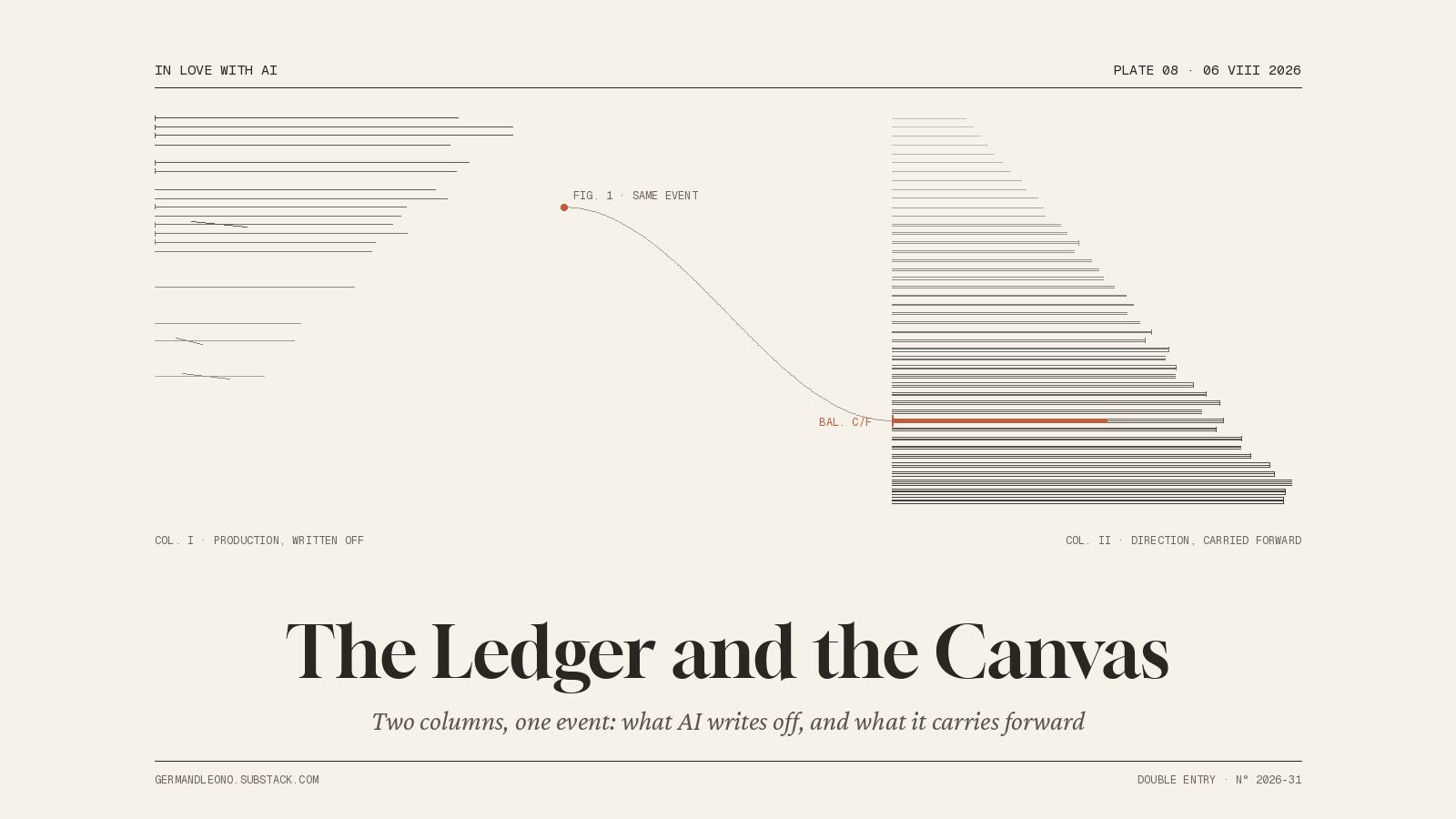
The essay: The layoff memo and the earnings call describe the same event
On Tuesday evening, two documents went out within hours of each other. One was Figma’s Q2 earnings release: $370 million in revenue, up 48%, the third straight quarter of accelerating growth, driven by customers burning AI credits at a pace that surprised even the company. The other was the daily update to the layoff trackers, which ticked past 205,000 workers cut in 2026, with AI leading the stated reasons for a fourth consecutive month.
Most people will read these as opposing stories. AI destroys design jobs; design tools have never been healthier. Pick your narrative, pick your evidence. I think that framing misses what is actually happening, and I want to argue that these two documents describe the same event from opposite sides of a ledger.
Here is the mechanism. When a company cites AI in a layoff memo, it is rarely saying “the machine now does what that person did.” It is saying something more specific: we have re-priced production. The work of turning decisions into artifacts, mockups into variants, specs into screens, copy into localizations has collapsed in cost. What has not collapsed in cost, what has arguably become more expensive, is the work of deciding what to produce, judging whether it is right, and owning the consequences when it is not.
Now look inside Figma’s numbers with that lens. The growth is not coming from more seats. It is coming from AI credits, metered units of machine production, consumed weekly by 80% of the company’s serious customers. Figma is not selling more chairs for more designers. It is selling machine labor, dispensed through the same canvas, directed by fewer people with more judgment per head. The seat is not disappearing. It is being re-metered. Companies used to pay for design capacity in humans; increasingly they pay for it in credits, and they keep the humans who know what to ask for and how to tell good from bad.
I have watched this exact sorting happen in my classrooms. After teaching more than a thousand students how to work with AI, I can tell you the split is visible within the first two sessions, and it has nothing to do with seniority or technical skill. Some students treat the model like a vending machine: insert prompt, receive artifact, ship it. Others treat it like a talented junior colleague with no context: they brief it, interrogate the output, feed back corrections, and build a working relationship with the system. The second group produces work that is not marginally better. It is categorically better, because they never surrendered the judgment. The layoff lists and the promotion lists are running the same sorting algorithm at industrial scale.
This is also why the research section of this issue matters more than it might seem. When business users across a rigorous mixed-methods study say they want agents that respect permissions and approval boundaries, embedded in tools they already use, they are describing the same re-metering from the buyer’s side. Nobody wants to buy autonomy. They want to buy production capacity that remains under their direction. The interface for direction, the brief, the review surface, the approval gate, and the audit trail is where design holds more power than it has had in a decade. In the last issue, I argued that somebody has to design the brake pedal. This issue’s numbers show who is paying for it: everyone, weekly, in credits.
For founders, the ledger reads differently but points the same way. The venture market spent this cycle telling us, in increasingly blunt terms, that a beautiful interface on top of someone else’s model is not a company. Figma’s quarter demonstrates the alternative. The moat is not the UX. The moat owns the workflow so completely that when AI production spend arrives, it has nowhere else to land. Every founder asking “what should we build with AI” is asking the wrong question. The question is: which workflow do you own, and does machine labor flow through it or around it?
And for designers, the honest version, the one I would want someone to tell me: the job that is disappearing is real, and pretending otherwise insults the 101,743 people on this year’s list. Production design as a full-time occupation is being repriced toward zero, not because it lacked value but because its value was always downstream of decisions someone else made. The job that is growing pays for exactly those decisions. Direction, taste, verification, and the curation of context that machines cannot infer. The cruelty of this transition is that both jobs have the same title on LinkedIn. The opportunity is that the tools for leaping are sitting in the same canvas you already work in, metered and waiting.
The layoff memo and the earnings call are the same event. The only question that matters is which column of the ledger you are in, and the uncomfortable, hopeful truth is that it is still largely a choice. What would it take for your next performance review to measure your judgment instead of your output?
Exclusive for newsletter readers: One number from the earnings call did not make it into the LinkedIn version of this argument, and it is the one I keep thinking about. Figma’s shares dipped after hours, not because the quarter disappointed but because Q3 guidance implied the growth might slow. Sit with that. The market now punishes a design company for suggesting that AI-driven expansion could decelerate, even for a quarter. Whatever your personal timeline for adapting to this shift was, the capital markets just told you theirs, and it is shorter. Investors are not debating whether design work gets re-metered. They are pricing the speed.
In love with AI is written by Germán León, founder at Helvetica Digital, from Barcelona. If this issue sharpened how you read the week, share it with one designer or founder who needs the ledger explained.