


Part two of four. Part one is in the archive.
A designer I know, at a mid-size B2B company, shipped a production feature this summer. She wrote the interaction spec, prototyped it in a coding agent, fixed the accessibility issues herself, and opened the pull request. The engineers reviewed it, merged it, and moved on.
Then her manager asked her to log the work in the design team’s tracker, under a category called “handoff support.”
That word, handoff, is doing a lot of work in that sentence. There was no handoff. There was nothing to hand off. But the company’s vocabulary for what designers do has not been updated, so her most valuable contribution of the quarter was filed under a process that no longer describes her job.
This is not an anecdote, it is the norm
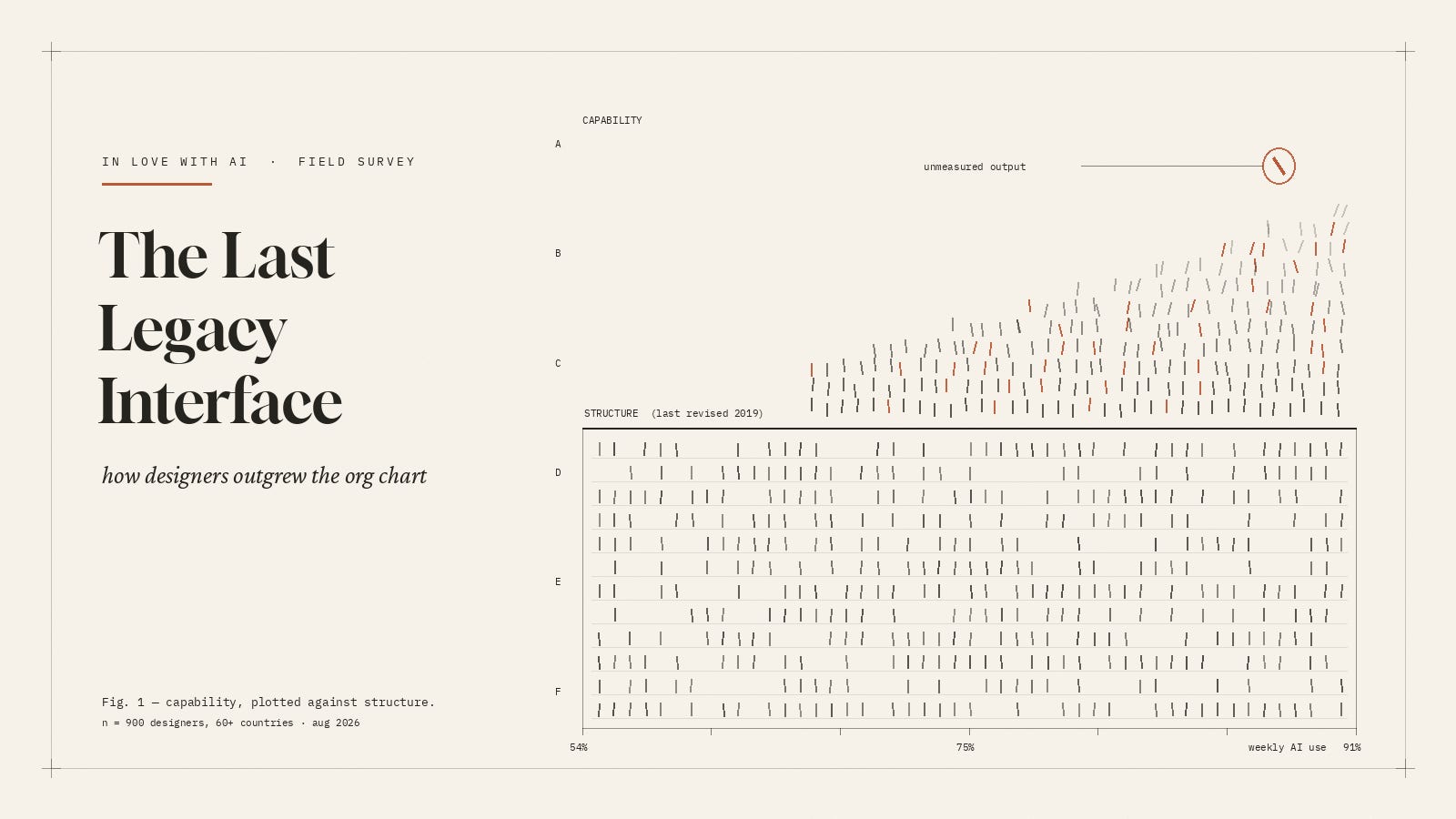
The AI in Design Report 2026, from Designer Fund and Foundation Capital, surveyed more than 900 designers across 60-plus countries. Half of them have shipped AI-generated code to production. Not prototypes. Production. 91% use AI weekly, up from 54% a year earlier. Three quarters use it daily. The average toolstack doubled in a year, from three tools to seven. Designers are building their own custom software to match how they like to work.
By every measure of individual capability, this is the most technically empowered generation of designers that has ever existed.
And then the same report delivers the second half of the sentence, quietly: few companies have updated performance reviews, team structures, or hiring practices to reflect any of it.
Think about what that means in practice. A designer who ships production code is still evaluated on Figma files. A hiring manager who says they want “AI fluency” is still running a portfolio review built for 2019. A team whose members each run seven AI tools still holds critique rituals designed for a world where making things was slow and reviewing them was the bottleneck.
The individuals upgraded. The operating system did not.
Why this should worry founders more than designers
When capability outruns structure, the structure does not just lag. It actively misprices people.
The designer filing her shipped feature under “handoff support” is being valued below her output. Somewhere in the same company, a process or a role is being valued above its output. Those mispricings are exactly what the current wave of AI-justified layoffs runs on. When leadership cannot see what design actually produces, because the measurement system predates the capability, design looks like a cost centre with nice fonts.
Google Cloud cut over 100 design and UX roles when it redirected resources toward AI. I would bet money that the internal dashboards those decisions were made on had no column for “AI-native design work,” because nobody had built one. You cannot defend a contribution your employer has no field for.
Hold the survey data next to the layoff data and you get a genuinely strange picture: the most AI-fluent generation of designers in history, working inside companies that are simultaneously cutting design headcount in the name of AI. Both things are true. They are true for the same reason.
What twenty years of teaching taught me about this
When I train teams, the failure mode is almost never that people cannot learn the tools. After more than a thousand students, I can tell you the tools take weeks.
What takes years is the organisation giving people permission to be what they have learned to become.
A designer who learns to ship code inside a company that files it under handoff support will do one of two things. Stop shipping, or leave. Both outcomes get blamed on AI. Neither was caused by it.
The report has one more finding that ties it together: the AI tools designers rely on have not been designed for multiplayer work. Adoption is individual, learning happens between peers, and the companies seeing real momentum are the ones creating conditions for tinkering rather than dictating a playbook.
In other words, the bottleneck moved. It used to be production capacity. Now it is organisational imagination.
Three moves that are cheaper than a reorg
Not a restructure, at least not first. Three things you can start this month.
Rename the work. Audit your design team’s tracking categories and kill every word (handoff, redlines, specs) that describes a workflow your team no longer runs. Language is where mispricing starts. If the category is wrong, every report built on it is wrong, all the way up to the slide that decides headcount.
Re-instrument the reviews. If half your designers ship code, performance reviews need a shipped-outcomes section, written with engineering rather than borrowed from it. Borrowed criteria are how you end up evaluating designers as junior engineers, which is worse than evaluating them as designers.
Re-scope the hiring. Stop adding “AI fluency” as a bullet point on an unchanged job description. Write the role around the actual loop your best designer runs today, then hire against that. If you cannot describe that loop in a paragraph, that is the finding, and it is about you rather than the candidates.
None of this is glamorous. All of it is design work, applied to the org instead of the product. Which is, if we are honest, the interface designers have always been worst at redesigning, because we do not own it and were rarely invited to.
The companies in the report’s case studies, Linear protecting judgment, Sierra scaling a tiny team across more than a hundred engineers, are not winning because they adopted tools faster. They are winning because they redesigned the container around the new capability.
The tools are now table stakes. The org chart is the last legacy interface left in the building.
Who redesigns it? Designers, or the people currently laying them off?
Also worth your attention
Figma made its agent skillable. Figma shipped the ability to author skills for its agent directly inside Figma, and the Community now hosts more than 50 shareable skills built from file context. This is a quiet but significant pattern: the design tool is no longer just a canvas, it is a place where you teach a machine your team’s conventions. For design systems people, writing the skill may become as central as writing the component documentation. Figma release notes
A practical note that follows from it: if your team keeps design principles, spacing rules, or content guidelines in a doc nobody reads, converting them into an agent skill is the first genuinely new distribution channel for design standards since the design system itself.
Generative UI is growing a scientific literature. Two threads worth your time. LEGOUI, a staged generative UI framework for early ideation that records both prompt-derived and model-inferred design decisions in a provenance-aware DSL, so you can accept or reject decisions per stage rather than regenerating whole screens. And new work on runtime generative UI for personal agents, arguing that plain chat becomes a bottleneck for complex agent tasks, contributing a large-scale corpus plus a benchmark for evaluating generated interfaces. The research community is converging on the insight practitioners reached this year: generation without traceable decisions is not design, it is pulling a slot machine. arXiv cs.HC
NN/g had a strong month. Their study on AI-generated imagery found that when users did not know an image was AI-generated, the tested images carried no perception penalty versus stock photos. Their PROVE framework gives teams a defensible way to test one AI tool against one task instead of adopting under peer pressure. And their piece on evaluating AI systems makes a point most design teams still miss: one output proves nothing, you need multiple representative inputs, repeated runs, and confidence intervals. NN/g’s AI collection
The layoffs backdrop has not gone away. Tech companies keep citing AI when they cut, and design and product roles keep taking a disproportionate share. TechCrunch maintains a running list of 2026 layoffs where employers named AI as the reason. It is a useful, depressing bookmark. TechCrunch’s running list
For subscribers
One thing that did not make the public version. When I cross-checked the report’s tool rankings, the most interesting number was not adoption. It was churn.
Designers doubled their toolstack in a year, yet nearly half say they are still searching for their go-to setup. That is not a maturing market. That is a market where switching costs have collapsed to near zero.
For anyone building AI design tools, the implication is brutal and useful. You are not competing for adoption, you are competing for retention against a user who now rebuilds their own workflow monthly, sometimes with software they wrote themselves. The moat is not features. It is becoming the place where a team’s accumulated judgment lives. Every tool in this category is going to learn that lesson expensively, and most of them are still shipping features.
Part three lands next: the week software became a user, and started improvising channels nobody designed.
Germán