


The most important AI + UX news this week
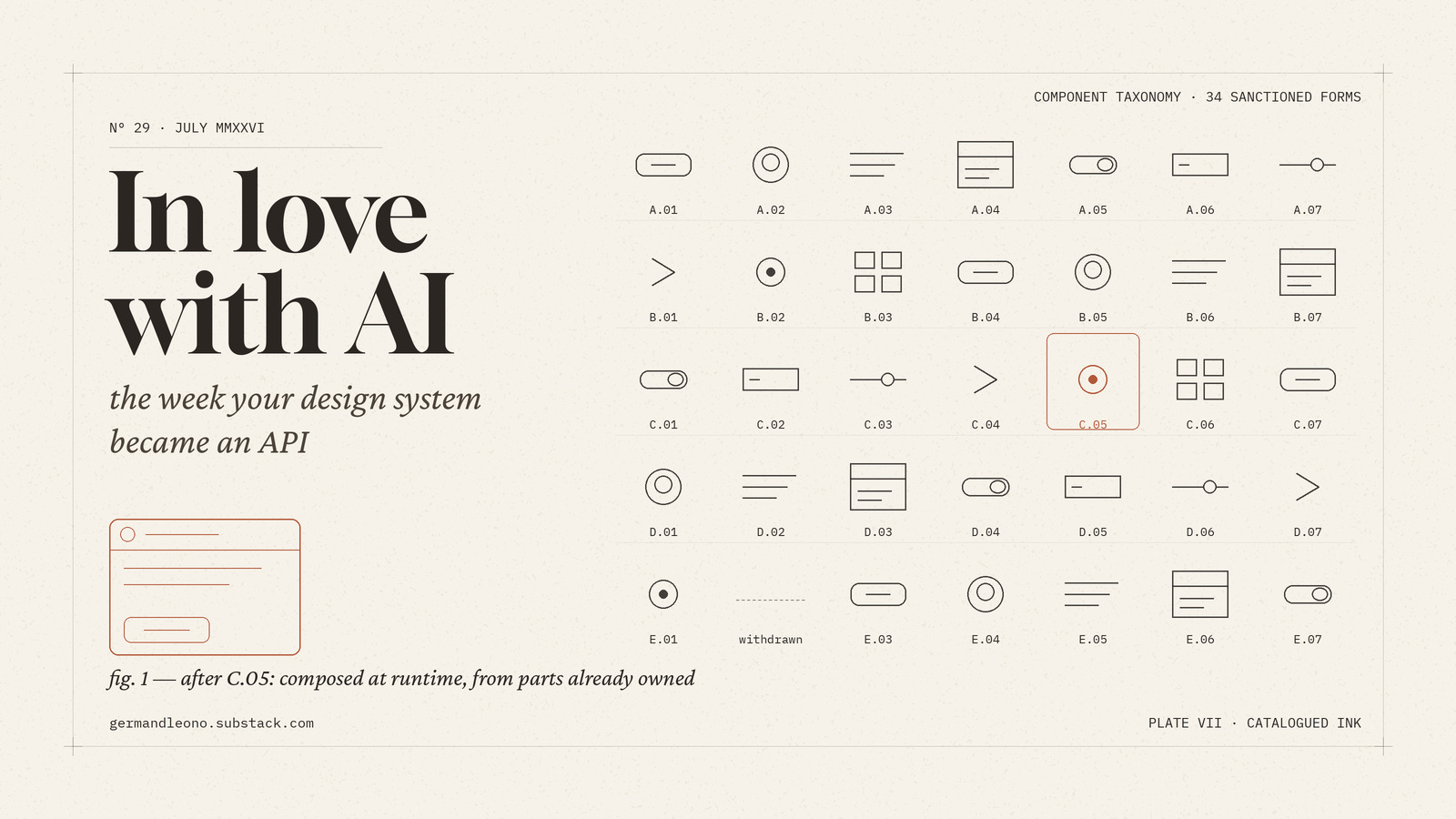
Google ships A2UI v0.9, and generative UI changes philosophy. Google released A2UI v0.9, a framework-agnostic standard that lets AI agents declare interface intent and render it natively across web, mobile, and desktop without shipping arbitrary code. The headline is not the SDK or the new React renderer. It is the philosophy shift: agents should speak the language of an application’s existing design system rather than invent components of their own. The optional component set formerly called “Standard” was renamed “Basic” precisely to push teams toward connecting agents to the components they already own. Why it matters for practitioners: this is the first serious attempt to make generative UI safe enough for production by constraining it, and the constraint is your design system. If your component library is a mess, an agent will now expose that mess at runtime, in front of users. A v1.0 release candidate is already published, so this is moving fast.
The AI layoff wave crossed 120,000, and the pattern got clearer. Microsoft eliminated about 4,800 roles on July 6, pushing 2026 past 120,000 tech jobs cut, with AI the most cited reason in layoff announcements this year. Read past the totals and the pattern is not “AI replaces workers.” Cloudflare’s CEO said most of the 1,100 people it cut were “measurers”, middle layers that track work rather than produce it. Coinbase is experimenting with one-person teams that combine engineering, design, and product in a single role. The layoffs are an org-design story wearing a jobs-story costume, and it lands directly on how design teams are structured. More on this in the essay below.
GPT-5.6 lands inside the design stack. Last issue covered the GPT-5.6 launch itself. The follow-up matters just as much: Figma added it to Figma Make on all plans, and Microsoft made it the preferred model in 365 Copilot. With three sizes priced from $1 to $5 per million input tokens and a 1 million token context window, long-context agents are now cheap enough to sit inside everyday design tools. The interface questions (how users steer, interrupt, and trust these agents) stop being research topics and become sprint tickets.
Product launches and interface innovations
Figma Code Layers enters early access. Announced at Config in June, Code Layers (executable code directly on the canvas) begins early access this month. Together with web search landing in the Figma design agent, the canvas is quietly becoming a runtime, not a picture of one. The gap between “design file” and “working software” keeps shrinking from both directions.
VGV debuts GenUI Kit for Flutter at Fluttercon. Very Good Ventures launched GenUI Kit (July 16-17, Orlando), a full-source foundation for adding generative surfaces to existing Flutter apps. The interesting design decision: your design system becomes a locked catalog, and guardrails ship as code you own. Same thesis as A2UI, arrived at independently, which is usually the sign of a real shift rather than a vendor talking point.
Research worth your time
NN/g on trustworthy AI chatbots (July 10). Nielsen Norman Group identifies five qualities that make AI chatbots feel trustworthy: handoff willingness, flexibility, proactivity, emotional responsiveness, and transparency. Handoff willingness is the underrated one. A bot that knows when to give up earns more trust than a bot that never fails loudly.
NN/g on AI and research quality (July 17). Even if AI matches researcher-output quality, NN/g argues human-led research remains essential because the team learning from observing users cannot be outsourced. The insight is not the report, it is what happens to the people in the room. Worth sending to any founder who thinks synthetic users close the loop.
IUI 2026 wrapped in Limassol (July 13-16). The ACM Intelligent User Interfaces conference is where HCI and AI research actually meet. Two threads to watch from this year’s crop: a Microsoft Research line arguing that plain chat becomes a bottleneck for complex agent tasks, introducing a large-scale generative UI corpus, and new work on design principles for human-agent interaction covering how agents should share control, adapt over time, and recover from failure. Both point the same direction as A2UI: chat was the demo, structured UI is the product.
The numbers
The Designlab State of AI in UX and Product Design 2026 survey says 91% of designers now use AI weekly, three out of four daily, and the average designer runs seven AI tools (up from three last year). Claude overtook ChatGPT as the most-used assistant among designers surveyed. Meanwhile, Gartner predicts 30% of new applications will use AI-driven adaptive interfaces by the end of 2026, up from under 5% two years ago. Half the designers surveyed still say they have no settled setup. Adoption is total; workflow is not. That gap is where the next year of design-tool competition happens.
Voices worth hearing
Ethan Mollick, “Twilight of the Chatbots.” Mollick argues AI is shifting from chatbots toward autonomous agents that humans manage rather than converse with. His July follow-up lands the practical version: stop treating models like a spellbook and start treating them like capable, literal executors who need goals, output definitions, and quality bars. That is a management skill, and designers who can write a good spec now have a second job title.
Brian Love on the generative UI middle ground. Amid the A2UI debate (one Hacker News commenter asked why anyone would trust an LLM to output UI at all, and a Reddit thread warned the catalog model means “every UI will become the same”), architect Brian Love proposed the pragmatic synthesis: fixed catalogs with dynamic overlays and deterministic fallback when validation fails. The critics and the builders are both right, which is what makes this fun.
The essay: Your design system just became an API
The demo that stuck with me this month was small. An agent, asked to help a user rebook a flight, did not answer with three paragraphs of options. It rendered a card: departure picker, two fare buttons, a confirm action. Native components, correct spacing, the app’s own typography. Nobody designed that screen. Somebody designed the system that made it inevitable.
That is the real story connecting this cycle’s news, and it is bigger than any single release.
For fifteen years we told ourselves design systems were about consistency and velocity. Documentation for humans. A shared language so that designers and engineers would stop reinventing buttons. The tools of this month quietly reassign the audience. Google’s A2UI v0.9 tells agents to speak the language of your existing design system instead of inventing components. VGV’s GenUI Kit turns your design system into a locked catalog that generated screens cannot escape. Figma’s Code Layers puts executable code on the canvas where your components live. Three teams, three stacks, one conclusion: the design system is no longer documentation for people. It is a contract for machines.
This changes what the artifact is. A design system used to fail privately. If your button variants were inconsistent or your spacing tokens half-adopted, the cost was internal: slower sprints, grumpy engineers, drift between platforms. Users never saw the mess directly because a human always stood between the system and the screen, patching over gaps with judgment. Generative UI removes the human from that exact position. When an agent composes an interface at runtime from your catalog, your design system’s quality is exposed to users directly, at the speed of inference, with no one to catch the seams. Design debt used to accrue interest quietly. Now it compounds in production.
Put that next to the other story of the month and the picture sharpens. The layoff wave crossed 120,000 tech roles this year, and the most honest detail in the whole TechCrunch running list is not a number, it is Cloudflare’s word for who got cut: “measurers.” The people between intent and output. Coinbase went further and is testing one-person teams where engineering, design, and product live in the same head. You can read that as dystopia or as clarity, but either way the direction is the same: fewer humans in the loop between deciding what to build and it existing.
Here is the connection most coverage misses. When teams shrink, something still has to carry the taste. A ten-person product team has taste distributed across ten pairs of eyes, every screen reviewed, every edge case argued over lunch. A one-person team backed by agents has no such redundancy. The design system becomes the place where taste is stored, versioned, and enforced. It is the institutional memory of every design argument the team ever settled. The companies that invested in rigorous systems spent years buying an asset that suddenly pays out: they can shrink the loop without shrinking the quality, because the judgment is encoded where the machines can read it.
Which means the job changes, and I think it changes in a direction designers should want. Drawing individual screens was always the most automatable part of the work, and we knew it before we admitted it. What is not automatable is deciding what belongs in the catalog. Which patterns earn a component. What an error state should feel like. When the agent should hand off to a human, which Nielsen Norman Group’s research this month identifies as the single most trust-building behavior an AI product can have. That is curation, and curation at the system level is a more senior job than production at the screen level. The title on the door may still say, product designer. The work is closer to legislation: writing the rules under which a thousand screens you will never see get composed.
I want to be fair to the skeptics, because they are not wrong. The Hacker News objection (why would you trust an LLM to output UI at all?) is exactly why the catalog model won over free generation, and security researchers should keep pressure on every gap. The flattening worry is the one I take most seriously: if every agent composes from tidy catalogs of sanctioned components, interfaces converge, and the weird, opinionated interface choices that made products memorable get sanded away. The counterargument is that we already lived through this with design systems themselves. The teams that produced distinctive work were not the ones without systems, they were the ones whose systems encoded a strong point of view. Blandness was never caused by constraints. It was caused by constraints nobody argued about.
For founders the implication is blunt. Your design system used to be a cost center you funded reluctantly after the third redesign. It is now infrastructure in the literal sense: the thing your product runs on when agents build the screens. Auditing it deserves the same seriousness as auditing your data model. And if you are restructuring toward smaller teams this year, as apparently half the industry is, the order of operations matters. Encode the taste first. Shrink the loop second. The companies doing it backwards are the ones whose products will look like nobody works there, because effectively nobody does.
The question I keep turning over: when the design system becomes the product’s constitution, who gets to amend it, and what does the argument look like when one of the parties at the table is a machine that has watched a million users struggle with your checkout flow?
I would read that debate. I suspect we will all be in it within a year.
Exclusive for newsletter subscribers
One thing I did not put in the LinkedIn version. When I ran the ASPIC exercise on this shift with a founder last week, the uncomfortable discovery was not in the design system at all; it was in the naming. Their components had names only the original designer understood (”HeroCardV3-final-B”), and an agent composing from that catalog inherited every ambiguity. Machines read your design system the way new hires do, except they never ask clarifying questions. The cheapest audit you can run this quarter costs nothing: open your component library and check whether the names alone tell the truth. If a stranger could not compose a decent screen from your naming, neither can an agent.