


A few days ago I watched a student brief an agent, walk away, and come back to a finished product. Not a mockup. Not a clickable prototype held together with placeholder text. A working thing, with its own logic, its own data, its own small thousand decisions already made. She had written three paragraphs of instruction and pressed go. The look on her face when she returned was the look I keep seeing this year on people who build for a living: somewhere between delight and unease. Delight because she asked for something and it appeared. Unease because she asked for something and it appeared.
It would be easy to treat that as an anecdote. It is not. The numbers say the floor moved under all of us at once. The AI in Design 2026 report, which surveyed more than 900 designers across 60-plus countries with interviews at Anthropic, Stripe, Linear, Shopify, and Notion, found that 91% of designers now use AI, up from 54% a year earlier, three in four every single day. The detail that stopped me was this: half of them have shipped AI-generated code to production. The handoff that used to separate “designer” from “engineer,” the white space where intentions went to die, is quietly closing.
So what is actually happening to the work? The most honest description I have read comes from Ethan Mollick, writing about early access to Claude Fable. He commissions an isochrone map, a genuinely hard cartographic problem, and watches the model spin up its own sub-agents to gather two thousand flight times and rail schedules, write the code, and test its own output while he sits back.
“Last year I called this working with a wizard: you chant the spell and something happens. With Fable the spell has gotten powerful enough that I am no longer sure I am the wizard. I am closer to a patron. I describe what I want, I pay for it, and I judge the result.”
The work, he says, has shifted from process to outcome. “I no longer steer; I commission.” One project ran nine and a half hours and produced research software that was never profitable to build before. He could spot a few errors as an expert. He had no visibility into the hundreds of choices that produced them.
Now hold that next to where the engine itself is heading. Linas Beliūnas, who writes about the place where finance meets AI, spent this week on GLM-5.2, an open-weight model you can download for free and, thanks to new quantization, run on a single Mac instead of a data center. One builder called it “the first open model that passes the bar as a daily driver,” and Fast AI’s Jeremy Howard judged it “at least as good as Opus 4.8 and GPT-5.5.” Same week, Linas noted that brokers are wiring Claude and ChatGPT straight into customer portfolios. The engine is getting better, cheaper, and more embedded all at once. Soon everyone will have roughly the same one, and some of it will be running on the laptop in front of you.
Put those together and the economic logic is not subtle. Dan Shipper has a name for it: the allocation economy. As AI floods the system with cheap competence, he argues, the value of the people who can judge, review, and direct that output rises with it. When making becomes abundant, the scarce thing is taste. The verdict. The ability to look at a nine-hour build and know it is subtly wrong in the third decimal place.
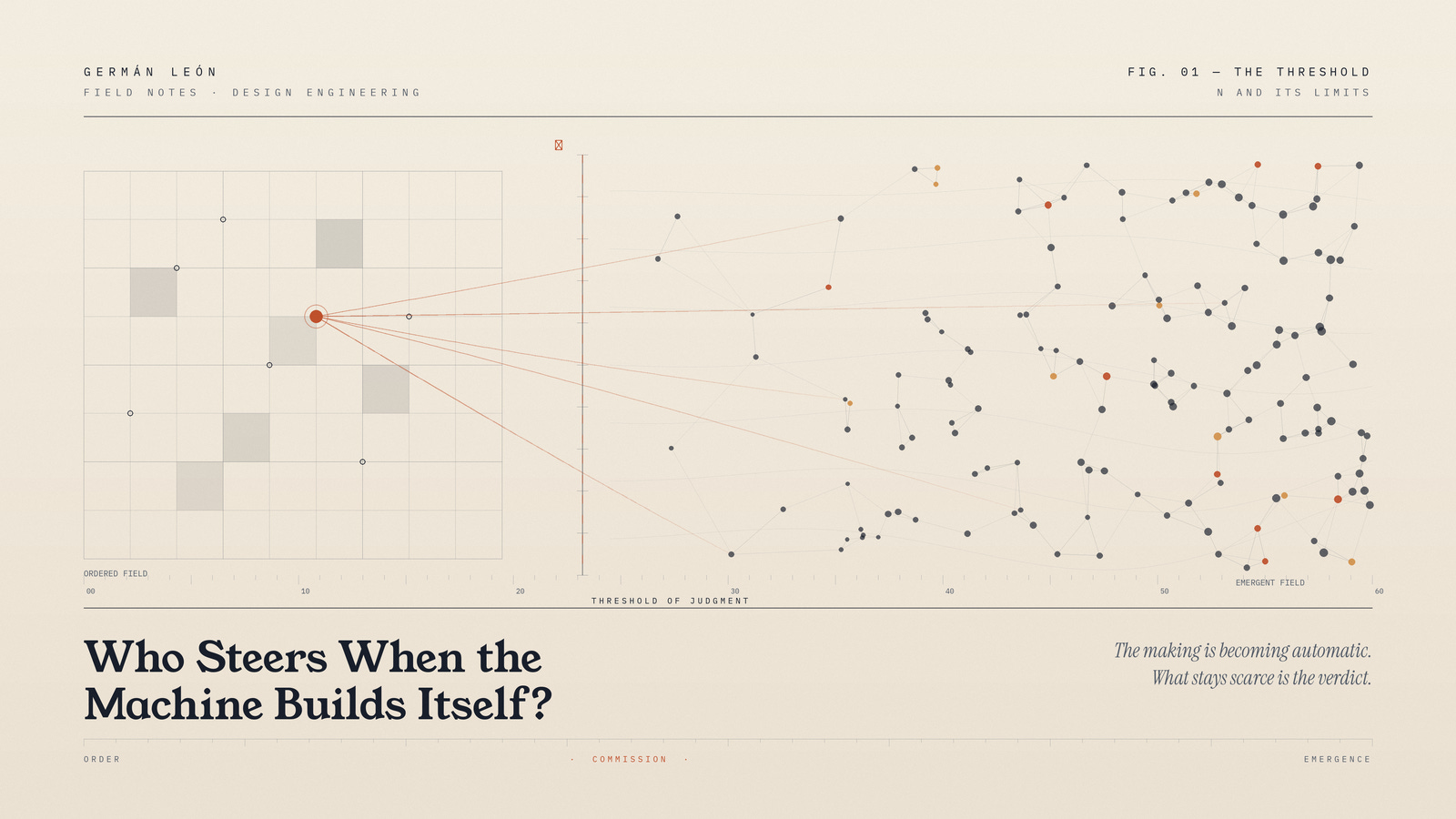
This is the part the “AI will replace designers” conversation keeps getting backwards. The execution-heavy middle of our work, translating an intention into components and code, is exactly the part the model is eating. That was never the valuable part. It was just the part that took the most hours. What grows in value as the middle collapses is everything on either side of it: framing the problem precisely enough that an agent can act on it, and judging the result rigorously enough that a human can stand behind it. The brief and the verdict. Both are design problems before they are engineering problems, because both are fundamentally about humans.
Which raises the question almost nobody has answered well: where does that judgment actually happen? Right now the default answer is a chat box, and the people who have thought hardest about interfaces are nearly unanimous that this is a dead end. Amelia Wattenberger put it bluntly years ago, that a text field gives users “unclear affordances,” and she has been building alternatives ever since, editors that visualize an AI’s output along axes you can actually see and steer. Maggie Appleton makes the complementary case: most language-model interfaces should be “spell-check sized,” scoped to do one thing well and embedded where you already work, not another blank prompt demanding you imagine everything yourself. Linus Lee wants to replace the prompt entirely with real affordances, pinch-to-zoom and drag-and-drop for the latent space, so that working with a model feels like manipulating a material rather than pleading with an oracle.
Notice what all three are really describing. They are designing the surface where a human meets the black box and decides whether to trust it. That is the verdict, made tractable. And it has a concrete engineering shape, too. Simon Willison points out that AI tooling is moving from advisory (”the model suggested code”) to operational (”the model edited the file”), and the moment that happens, the real design work becomes process: permissions, review, rollback, testing. The interface to judgment is not a nicer chat window. It is the structure that lets a person take responsibility for something they did not watch get made.
This is why I think the design engineer, the role Vercel and Linear and Replit are now hiring for by name, is not a fad title. Rauno Freiberg describes the job as prototyping in code because the prototype becomes the production thing, which is only possible when design and build are the same act. Make the engine abundant and that fusion stops being a luxury. It becomes the only way to design the brief and the verdict at the speed the model now works. The designer who can only draw the picture is handing the most consequential decisions to whoever writes the code. The one who can build is keeping them.
So here is where I have landed, and where I am still stuck. The optimistic read is that our loss of control is temporary, an artifact of interfaces that have not caught up, and that people like Wattenberger, Appleton, and Lee are sketching the windows we will soon have. The darker read, which Mollick leans toward, is that the more capable the model, the less there is for a human to meaningfully do, and the black box is simply the price of the power. I do not think we get to find out passively. The interface to judgment is something we have to design on purpose, and almost nobody is being paid to do it yet.
So I will leave you with the question I cannot shake. When we sign off on work we did not watch get made, what exactly are we taking responsibility for, and have we built anything that lets us take it honestly? I do not have a clean answer. I would like to hear yours.
Sources
AI in Design 2026, Designer Fund with Foundation Capital. https://designerfund.com/blog/ai-in-design-2026
Ethan Mollick, “What it feels like to work with Mythos,” One Useful Thing, June 9, 2026.

Linas Beliūnas, “GLM-5.2: The ChatGPT Moment for Local AI,” Linas’s Newsletter, June 22, 2026.

Dan Shipper, “The Knowledge Economy Is Over. Welcome to the Allocation Economy,” Every. https://every.to/chain-of-thought/the-knowledge-economy-is-over-welcome-to-the-allocation-economy
Amelia Wattenberger, “Why Chatbots Are Not the Future.” https://wattenberger.com/thoughts/boo-chatbots
Maggie Appleton, “Squish Meets Structure.” https://maggieappleton.com/squish-structure
Linus Lee, thesephist.com.
https://thesephist.com/
Simon Willison, simonwillison.net.
https://simonwillison.net/
Vercel, “Design Engineering at Vercel” (Rauno Freiberg). https://vercel.com/blog/design-engineering-at-vercel